


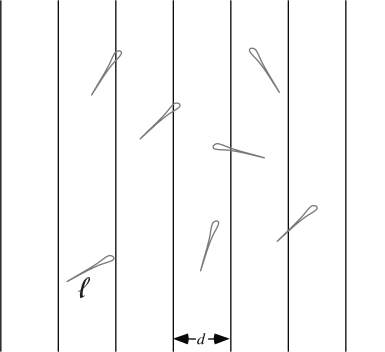
Buffon's needle problem asks to find the probability that a needle of length  will land on a line, given a floor
with equally spaced parallel lines
a distance
will land on a line, given a floor
with equally spaced parallel lines
a distance  apart, with
  .
The needle's midpoint is uniformly
distributed modulo the line spacing, independently
of its uniform orientation. The problem was
first posed by the French naturalist Buffon (Buffon 1733, pp. 43-45), and reproduced
with solution by Buffon (1777, pp. 100-104).
.
The needle's midpoint is uniformly
distributed modulo the line spacing, independently
of its uniform orientation. The problem was
first posed by the French naturalist Buffon (Buffon 1733, pp. 43-45), and reproduced
with solution by Buffon (1777, pp. 100-104).
Define the size parameter  by
by
 |
(1)
|
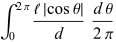
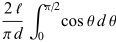
For a short needle (i.e., one shorter than the distance between two lines, so that  ),
the probability
),
the probability  that the needle falls on a line
is
that the needle falls on a line
is
 |  |  |
(2)
|
 |  |  |
(3)
|
 |  |  |
(4)
|
 |  |  |
(5)
|
For  ,
this therefore becomes
,
this therefore becomes
 |
(6)
|
(OEIS A060294).
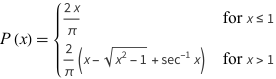
For a long needle (i.e., one longer than the distance between two lines so that  ),
the probability that it intersects
at least one line is the slightly more complicated expression
),
the probability that it intersects
at least one line is the slightly more complicated expression
 |
(7)
|
where  is the inverse secant on
  (Uspensky 1937, pp. 252 and 258; Kunkel).
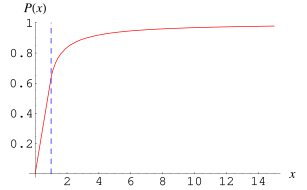
Writing
 |
(8)
|
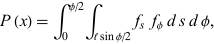
then gives the plot illustrated above. The above can be derived by noting that
 |
(9)
|
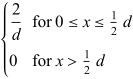
where
 |  |  |
(10)
|
 |  |  |
(11)
|
are the independent probability density functions for the distance  of the needle's midpoint from
the nearest line and the angle
of the needle's midpoint from
the nearest line and the angle  formed by the needle and the lines,
intersection takes place when
formed by the needle and the lines,
intersection takes place when  , and
, and  can be restricted to
 ![[0,pi/2]](/images/equations/BuffonsNeedleProblem/Inline33.svg) by symmetry.
by symmetry.
Let  be the number of line crossings in
  independent tosses
of a needle with
independent tosses
of a needle with  ,
where
,
where  is a positive integer. Then
  has a binomial distribution
with parameters
has a binomial distribution
with parameters  and
and  .
A point estimator for
.
A point estimator for  is given by
 |
(12)
|
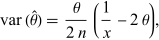
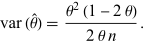
which is both a uniformly minimum variance unbiased estimator and a maximum likelihood estimator (Perlman and Wichura 1975) with variance
 |
(13)
|
which, in the case  , gives
 |
(14)
|
For  ,
the reciprocal estimator
,
the reciprocal estimator  for
for  , known as Buffon's estimator, is given by
 |
(15)
|
where  ,
,
 is the number of throws, and
  is the number of line crossings.
Set
is the number of line crossings.
Set  when
when  .
With this convention, it is asymptotically unbiased, meaning that its expectation
value tends to
.
With this convention, it is asymptotically unbiased, meaning that its expectation
value tends to  , and converges in
probability to
, and converges in
probability to  as
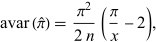
as  . It has asymptotic variance
 |
(16)
|
which, for the case  , becomes
 |  |  |
(17)
|
 |  |  |
(18)
|
(OEIS A114598; Mantel 1953; Solomon 1978, p. 7).
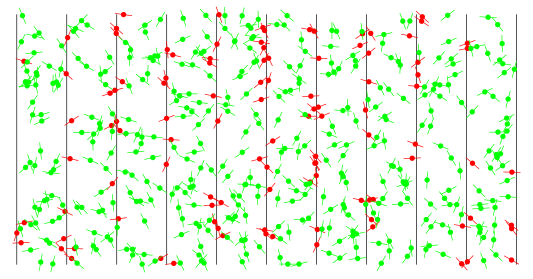
The above figure shows the result of 500 tosses of a needle of length parameter  , where needles crossing a line
are shown in red and those missing are shown in green. 107 of the tosses cross a
line, giving
, where needles crossing a line
are shown in red and those missing are shown in green. 107 of the tosses cross a
line, giving  . Substituting this estimate into
the asymptotic variance formula gives an approximate
standard error of 0.267.
. Substituting this estimate into
the asymptotic variance formula gives an approximate
standard error of 0.267.
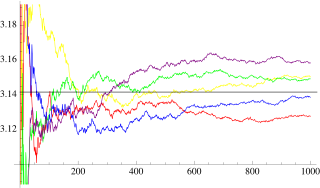
Several attempts have been made to experimentally determine  by needle-tossing.
  calculated from five independent
series of tosses of a (short) needle are illustrated above for one million tosses
in each trial with
calculated from five independent
series of tosses of a (short) needle are illustrated above for one million tosses
in each trial with  . For a discussion of the relevant statistics
and a critical analysis of one of the more accurate (and least believable) needle-tossings,
see Badger (1994). Uspensky (1937, pp. 112-113) discusses experiments conducted
with 2520, 3204, and 5000 trials.
. For a discussion of the relevant statistics
and a critical analysis of one of the more accurate (and least believable) needle-tossings,
see Badger (1994). Uspensky (1937, pp. 112-113) discusses experiments conducted
with 2520, 3204, and 5000 trials.
The problem can be extended to a "needle" in the shape of a convex polygon with generalized diameter less
than  ,
using independent uniform
translation modulo the line spacing and uniform
orientation. The probability that the boundary
of the polygon will intersect one of the lines
is given by
,
using independent uniform
translation modulo the line spacing and uniform
orientation. The probability that the boundary
of the polygon will intersect one of the lines
is given by
 |
(19)
|
where  is the perimeter of the polygon (Uspensky 1937, p. 253;
Solomon 1978, p. 18).
is the perimeter of the polygon (Uspensky 1937, p. 253;
Solomon 1978, p. 18).
A further generalization obtained by throwing a needle on a board ruled with two sets of perpendicular lines is called the Buffon-Laplace needle problem.

 ." Math. Mag. 67,
83-91, 1994.Bogomolny, A. "Buffon's Noodle."
." Math. Mag. 67,
83-91, 1994.Bogomolny, A. "Buffon's Noodle."  ." Ch. 1 in