

A Brazilian number is a positive integer  that is a repdigit
in some base
 with
 . The upper bound
excludes the representation of every
 as
 . The definition appeared
in a problem at the 1994 Iberoamerican Mathematical Olympiad in Fortaleza, Brazil
(Schott 2010).
If the repeated digit is  and the representation has length
 , then
 |
where  and
 . For example,
 . The first Brazilian numbers are 7, 8, 10, 12,
13, 14, 15, 16, 18, 20, ... (OEIS A125134).
The only composite numbers that are not Brazilian are 6 and the squares of primes
other than 11. In particular,  is the only Brazilian square of a prime
number (Schott 2010).
A Brazilian prime is a Brazilian number that is a prime number. Its repeated digit must be 1, so the Brazilian primes are precisely the repunit primes that have at least three digits in some base. The length of such a representation must be an odd prime number, since a repunit of composite length is divisible by a shorter repunit in the same base. The first Brazilian primes are 7, 13, 31, 43, 73, 127, 157, 211, 241, 307, ... (OEIS A085104).
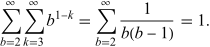
It is unknown whether there are infinitely many Brazilian primes, but the sum of their reciprocals converges (Schott 2010). A repunit
of length  in base
 exceeds
 , so the sum of the reciprocals
of all such repunits, counted with multiplicity, is bounded
by
 |
The Brazilian primes 31 and 8191 each have two qualifying repunit representations. The Goormaghtigh
conjecture asserts that these are the only integers
with such representations in two distinct bases (Grantham
2024). Schott (2010) conjectured that no Brazilian prime
number is also a Sophie Germain prime.
The number  is a counterexample (Grantham and Graves 2020).

 ." Integers 24,
Article A98, 2024.