

Borsuk's conjecture (Borsuk 1932) asserts that every bounded set of  -dimensional Euclidean space
of generalized diameter 1 can be partitioned
into
-dimensional Euclidean space
of generalized diameter 1 can be partitioned
into  pieces of strictly smaller generalized diameter.
It is true for
pieces of strictly smaller generalized diameter.
It is true for  and 3 and for sets with smooth boundary.
However, the number of pieces required in the worst case grows at least exponentially
in
and 3 and for sets with smooth boundary.
However, the number of pieces required in the worst case grows at least exponentially
in  ,
so the conjecture is false in sufficiently high dimensions.
,
so the conjecture is false in sufficiently high dimensions.
Kahn and Kalai (1993) found a counterexample in dimension 1326, Nilli (1994) a counterexample in dimension 946.
Hinrichs and Richter (2003) showed that the conjecture is false for all 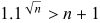 .
.
Bondarenko (2014) reduced the dimension of a counterexample to 65, and Jenrich and Brouwer (2014) reduced it to 64. With assistance from GPT-5.5
Pro, Grinsztajn (2026) supplied a construction in dimension
63 with 321 points such that a subset
of smaller generalized diameter has at most
five points. At least ![[321/5]=65](/images/equations/BorsuksConjecture/Inline6.svg) pieces are therefore required, where
pieces are therefore required, where ![[x]](/images/equations/BorsuksConjecture/Inline7.svg) is the ceiling function,
exceeding
is the ceiling function,
exceeding  .
This lowers the smallest dimension with a known counterexample
to 63 without determining the smallest possible dimension.
.
This lowers the smallest dimension with a known counterexample
to 63 without determining the smallest possible dimension.

 -dimensionalen Vollkugel in
  Mengen." Verh. Internat. Math.-Kongr. Zürich 2,
192, 1932.Borsuk, K. "Drei Sätze über die
Mengen." Verh. Internat. Math.-Kongr. Zürich 2,
192, 1932.Borsuk, K. "Drei Sätze über die  -dimensionale euklidische Sphäre." Fund. Math. 20,
177-190, 1933.Cipra, B. "If You Can't See It, Don't Believe It...."
Science 259, 26-27, 1993.Cipra, B.
-dimensionale euklidische Sphäre." Fund. Math. 20,
177-190, 1933.Cipra, B. "If You Can't See It, Don't Believe It...."
Science 259, 26-27, 1993.Cipra, B.