

The Boltzmann distribution is the discrete statistical distribution in which a state of energy  has probability
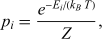 |
where
 |
and  is the absolute temperature,
  is the Boltzmann constant that converts temperature
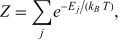
to energy, and the normalizing sum
is the Boltzmann constant that converts temperature
to energy, and the normalizing sum  ensures that
  . Consequently, the ratio of the probabilities
of two states is
. Consequently, the ratio of the probabilities
of two states is  .
.
At high temperature, states with different finite energies have more nearly equal probabilities. At low temperature, states of lower energy receive exponentially greater probability. If an energy value is shared by several states, the total probability of that energy level is multiplied by the number of states sharing it.
