

The bitangent vector  for differentiable scalar functions
  and
and  on a surface
  is the unit vector lying in
the tangent plane for which
is the unit vector lying in
the tangent plane for which  and
and  is positive. In computer graphics, the
functions
is positive. In computer graphics, the
functions  and
and  often represent texture coordinates for a 3-dimensional polygonal model. A rendering
technique known as bump mapping orients the basis vectors
of the tangent plane at any point
often represent texture coordinates for a 3-dimensional polygonal model. A rendering
technique known as bump mapping orients the basis vectors
of the tangent plane at any point 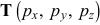 so that they are aligned with the direction
in which the derivative of
so that they are aligned with the direction
in which the derivative of  or
or 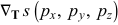 is zero. In this context, the tangent
vector
is zero. In this context, the tangent
vector 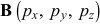 is specifically defined to be the unit vector lying
in the tangent plane for which
is specifically defined to be the unit vector lying
in the tangent plane for which  and
and 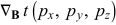 is positive. The vectors
  and
and  are not necessarily orthogonal and may not exist for poorly
conditioned functions
are not necessarily orthogonal and may not exist for poorly
conditioned functions  and
and  .
.
The vector 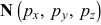 given by
 |
is a unit normal to the surface  at the point
  . For a closed surface
  , this normal vector can be characterized as outward-facing
or inward-facing. The basis vectors of the local tangent space at the point
, this normal vector can be characterized as outward-facing
or inward-facing. The basis vectors of the local tangent space at the point  are defined to be
  ,
,  , and
, and  , with
  negated in the case that it is inward-facing.
