

Bernoulli's paradox is the apparent contradiction obtained by assuming that the harmonic series
has a finite sum  and then deriving
  (Boas 1979, Dunham 1987). It provides a proof
by contradiction that the harmonic series
diverges.
(Boas 1979, Dunham 1987). It provides a proof
by contradiction that the harmonic series
diverges.
Suppose that
 |
(1)
|
For each positive integer  , the telescoping series
identity
, the telescoping series
identity
 |
(2)
|
expresses  as a sum of positive terms. Substituting these expansions
gives a double series. Under the assumption that
as a sum of positive terms. Substituting these expansions
gives a double series. Under the assumption that
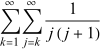
 is finite, its positive terms may be regrouped by
  without changing the sum. For a fixed
 ,
the term
,
the term ![1/[j(j+1)]](/images/equations/BernoullisParadox/Inline8.svg) occurs once for each of
occurs once for each of  , ...,
  , hence exactly
  times. Therefore,
 |  |  |
(3)
|
 |  |  |
(4)
|
 |  |  |
(5)
|
 |  |  |
(6)
|
This gives  ,
which is impossible for finite
,
which is impossible for finite  . The harmonic series therefore
diverges (Dunham 1987, pp. 19-21).
. The harmonic series therefore
diverges (Dunham 1987, pp. 19-21).
