


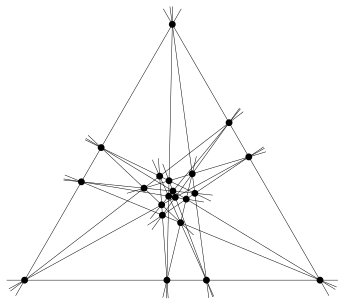
The Berman-Gévay-Pisanski configuration is the term used in this work for the geometric, self-dual  polycyclic configuration
denoted
polycyclic configuration
denoted  by Berman et al. (2024) and having threefold
rotational symmetry. The Grünbaum-Rigby
configuration is also a geometric
by Berman et al. (2024) and having threefold
rotational symmetry. The Grünbaum-Rigby
configuration is also a geometric  polycyclic configuration,
but the two are not combinatorially isomorphic.
polycyclic configuration,
but the two are not combinatorially isomorphic.
The Berman-Gévay-Pisanski and Grünbaum-Rigby configurations are exactly the two geometric  polycyclic configurations,
while there are 17 combinatorial polycyclic
configurations of order
polycyclic configurations,
while there are 17 combinatorial polycyclic
configurations of order  (Berman et al. 2024). The construction of
  disproved the conjecture
of Grünbaum and Rigby (1990) that no other geometric 214
configuration exists.
disproved the conjecture
of Grünbaum and Rigby (1990) that no other geometric 214
configuration exists.
The Levi graph of the configuration, known in this work as the Berman-Gévay-Pisanski graph, is a connected quartic graph and bipartite graph with 42 vertices and 84 edges. Its automorphism group has order 12, compared with 672 for the Grünbaum-Rigby graph. Thus, just as the Berman-Gévay-Pisanski and Grünbaum-Rigby configurations are distinct, their Levi graphs are nonisomorphic (Berman et al. 2024).

 ) Polycyclic Configuration." Elec. J. Combin. 31,
P4.54, 2024.
) Polycyclic Configuration." Elec. J. Combin. 31,
P4.54, 2024.  )." J. London Math. Soc. 41, 336-346,
1990.
)." J. London Math. Soc. 41, 336-346,
1990.