

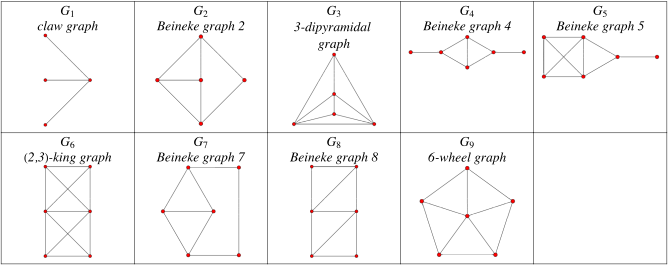
The Beineke theorem states that a finite simple graph is the line graph of a finite simple graph iff it has no induced subgraph isomorphic to any of the nine Beineke graphs illustrated above (Beineke 1970).
Every induced subgraph of a line graph  is itself a line graph. Indeed, the selected vertices
of
 correspond to a subset of the edges
of
 . Keeping just those edges
in
 gives a subgraph whose line
graph is the selected induced subgraph of
 . Each of the nine forbidden
induced subgraphs is minimal, so every proper induced
subgraph of each is a line graph (Beineke 1970).
