


Arnold's cat map is an Anosov diffeomorphism of the 2-torus  . Using unit-square
representatives, it is given by the transformation
 |
(1)
|
where  and
 are computed modulo 1. Write
 for this matrix and
 for the resulting map. It is area-preserving
since
 . As a map of the torus,
it is a real analytic diffeomorphism
and a mixing transformation with respect
to Lebesgue measure. The jumps in the unit-square
representation come from the cuts used to represent the torus.
The induced action on the first homology group is  , so
 is not isotopic to the identity
map. In particular, it is not a Hamiltonian
diffeomorphism of the torus, even though it preserves
area.
The eigenvalues of  satisfy
 |
(2)
|
so
 |
(3)
|
The corresponding Lyapunov characteristic exponents are
 |
(4)
|
The eigenvectors are found by plugging  into the matrix equation
 |
(5)
|
For  , the solution is
 |
(6)
|
where  is the golden ratio, so the unstable (normalized)
eigenvector is
 |
(7)
|
Similarly, for  , the solution is
 |
(8)
|
so the stable (normalized) eigenvector is
 |
(9)
|

The figure above shows the unit square, its linear image under  , and the pieces wrapped back
modulo 1. The colors identify corresponding pieces, with their boundaries
drawn to show the cuts.
For a semialgebraic set  , its image
can be calculated by stretching, cutting, and translating,
 |
(10)
|
where  and
 is the linear image of
 under
 . Only these six integer translations are needed because
![AQ subset [0,2)×[0,3)](/images/equations/ArnoldsCatMap/Inline20.svg) . Each piece is a semialgebraic
set, so cylindrical algebraic
decomposition can be used for exact iteration of
such regions (Trott 2006b). Keeping the indicated endpoint
conventions assigns points on the cuts exactly once.
For a positive integer  , reducing integer coordinates modulo
 instead gives a permutation
of an
 grid. The matrix powers are
 |
(11)
|
for  , where
 is a Fibonacci number
(Dyson and Falk 1992, p. 604; Trott 2006a). The least
period of this permutation is the smallest positive integer
 for which
 , where
 is the identity matrix.
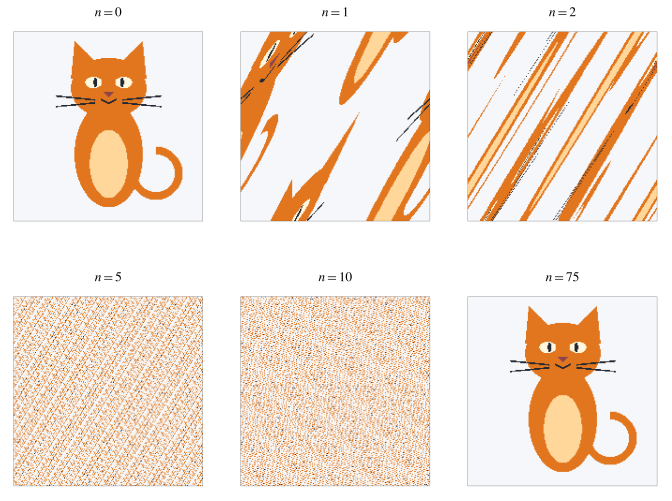
The figure above shows a cat image on a  grid after 0, 1, 2, 5, 10, and 75 iterations.
The grid map with
 has least period 75, so
the last panel reproduces the original image. Individual periodic
points can have smaller least periods, as the
origin is a fixed point.
