


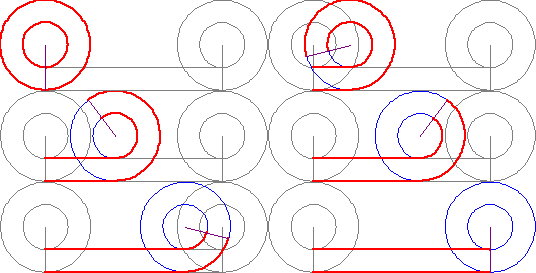
Aristotle's wheel paradox is a paradox mentioned in the Greek work Mechanica, dubiously attributed to Aristotle. Consider the above diagram depicting a wheel consisting of two concentric circles of different diameters (a wheel within a wheel). There is a 1:1 correspondence of points on the large circle with points on the small circle, so the wheel should travel the same distance regardless of whether it is rolled from left to right on the top straight line or on the bottom one. this seems to imply that the two circumferences of different sized circles are equal, which is impossible.
The fallacy lies in the assumption that a one-to-one correspondence of points means that two curves must have the same length. In
fact, the cardinalities of points in a line
segment of any length (or even an infinite line,
a plane, a three-dimensional space,
or an infinite dimensional Euclidean space) are
all the same:  (the cardinality of the continuum), so the points of
any of these can be put in a one-to-one
correspondence with those of any other.
(the cardinality of the continuum), so the points of
any of these can be put in a one-to-one
correspondence with those of any other.
