TOPICS
Search

Antideterministic Sequence


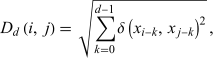
An antideterministic sequence is a sequence generated by selecting new terms to discourage repetitions of earlier blocks (Urbanowicz et al. 2005). One construction starts with terms x_1, ..., x_N in the closed interval [0,1] and integers d>=1 and m>=0, with N>=d+m. For a candidate new term x_(N+1)=u, define the block distance

 D_d(i,j)=sqrt(sum_(k=0)^(d-1)delta(x_(i-k),x_(j-k))^2),
(1)

where delta(a,b)=|a-b| or, with the interval endpoints identified, delta(a,b)=min(|a-b|,1-|a-b|). The utility function is

 U_N(u)=min_(d+m<=j<=N)product_(kappa=0)^mD_d(j-kappa,N+1-kappa),
(2)

and the next term is chosen to satisfy

 U_N(x_(N+1))=max_(0<=u<=1)U_N(u).
(3)

For m=0, this maximizes the distance from the new block to its nearest earlier block. The maximum exists by continuity on the closed interval [0,1]. Choosing the least maximizing argument resolves ties and makes the rule deterministic once the seed is fixed. Some seeds can make U_N identically zero, so the rule alone does not guarantee nonperiodic behavior.

The construction aims to suppress close parallel diagonal patterns in a recurrence plot. The periodic-distance version is used by Trott (2006).


See also

Recurrence Equation, Recurrence Plot, Sequence

Explore with Wolfram|Alpha

References

Trott, M. "Solution of Equations." §1.5 in The Mathematica GuideBook for Symbolics. New York: Springer-Verlag, 2006. https://doi.org/10.1007/0-387-28815-5. https://www.mathematicaguidebooks.org/.Urbanowicz, K.; Kantz, H.; and Hołyst, J. A. "Anti-Deterministic Behaviour of Discrete Systems That Are Less Predictable than Noise." Physica A 350, 189-198, 2005. https://doi.org/10.1016/j.physa.2004.11.065. https://arxiv.org/abs/cond-mat/0408429.

Cite this as:

Weisstein, Eric W. "Antideterministic Sequence." From MathWorld--A Wolfram Resource. https://mathworld.wolfram.com/AntideterministicSequence.html

Subject classifications