

The analyst's traveling salesman theorem characterizes the bounded sets in the plane that lie on a one-dimensional rectifiable set. For a dyadic
square  , let
, let  be the concentric square with three times the side length
and define
be the concentric square with three times the side length
and define
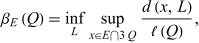 |
where the infimum is over all lines,  is the distance from
  to
to  , and
, and  is the side length of
  . The value
  measures how closely
  resembles a straight line at the location and scale of
  .
.
The theorem states that a bounded set  is contained in a curve
of finite arc length iff
is contained in a curve
of finite arc length iff
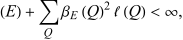 |
where the sum is over all dyadic squares (Jones 1990). Unlike the classical traveling salesman problem, the theorem is a geometric characterization rather than an algorithm for visiting a finite list of points.
