

An alternating factorial prime is an integer sequence prime that is an alternating factorial
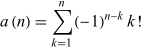 |
that is a prime number. The first few indices  for which
  is prime or a probable
prime are 3, 4, 5, 6, 7, 8, 10, 15, 19, 41, 59, 61, 105, 160, 661, 2653, 3069,
3943, 4053, 4998, 8275, 9158, 11164, 43592, 59961, ... (OEIS A001272;
extending Guy 1994, p. 100). Živković (1999) proved that only finitely
many alternating factorials are prime.
Specifically, he found that the prime number
is prime or a probable
prime are 3, 4, 5, 6, 7, 8, 10, 15, 19, 41, 59, 61, 105, 160, 661, 2653, 3069,
3943, 4053, 4998, 8275, 9158, 11164, 43592, 59961, ... (OEIS A001272;
extending Guy 1994, p. 100). Živković (1999) proved that only finitely
many alternating factorials are prime.
Specifically, he found that the prime number  divides
  ,
so the recurrence relation
,
so the recurrence relation  shows that
  divides
  for every
  . Under a heuristic model, he estimated the
total number of prime values to be about
. Under a heuristic model, he estimated the
total number of prime values to be about  . The number
  was verified to be prime
in Jul. 2000 by a team of G. La Barbera and others using the Certifix program
developed by Marcel Martin (Jobling 2004).
was verified to be prime
in Jul. 2000 by a team of G. La Barbera and others using the Certifix program
developed by Marcel Martin (Jobling 2004).
The following table summarizes the largest known alternating factorial probable primes. Rodenkirch (2017) completed a search through  showing that none of the additional values through
that limit is a probable prime. Rodenkirch (2026a)
announced plans to sieve through
showing that none of the additional values through
that limit is a probable prime. Rodenkirch (2026a)
announced plans to sieve through 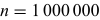 . Rodenkirch (2026b) subsequently reported modifying
PFGW to support alternating factorials and
obtaining a sieve bound of
. Rodenkirch (2026b) subsequently reported modifying
PFGW to support alternating factorials and
obtaining a sieve bound of  , with about 425,000 candidates remaining for
  . He planned to verify the implementation
over
. He planned to verify the implementation
over  .
.
 | decimal digits | discoverer |
| 11164 | 40344 | P. Jobling, Nov. 25, 2004 |
| 43592 | 183312 | S. Balatov, Jul. 19, 2017 |
| 59961 | 260448 | M. Rodenkirch, Sep. 18, 2017 |

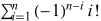 Is Finite." Math. Comput. 68,
403-409, 1999.
Is Finite." Math. Comput. 68,
403-409, 1999.