

The Alon-Tarsi number  of a graph
  is the least positive integer
  such that the graph polynomial of
  contains a monomial with nonzero coefficient in which every variable
has exponent less than
contains a monomial with nonzero coefficient in which every variable
has exponent less than  . To write the definition explicitly,
label the vertices of
. To write the definition explicitly,
label the vertices of  by
by  , ...,
  , choose a graph orientation
of its edges, and form
, choose a graph orientation
of its edges, and form
 |
(1)
|
If
 |
(2)
|
then equivalently
 |
(3)
|
It is independent of the chosen graph orientation and is an upper bound for the choice
number of  by the combinatorial nullstellensatz
(Alon and Tarsi 1992).
by the combinatorial nullstellensatz
(Alon and Tarsi 1992).
More generally, the same formula defines the Alon-Tarsi number of a nonzero polynomial.
For a hypergraph  with
with  and no empty hyperedges,
a hypergraph polynomial
has the form
and no empty hyperedges,
a hypergraph polynomial
has the form
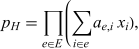 |
(4)
|
where every coefficient  is nonzero. The polynomial
is fully balanced when its coefficients are equal
within each hyperedge. Multiplying each factor by a
nonzero scalar then normalizes
those coefficients to 1. It is fully unbalanced when
every hyperedge has at least two unequal coefficients.
Anholcer et al. (2026) prove that the fully balanced polynomial
over a field of field
characteristic zero has Alon-Tarsi number
is nonzero. The polynomial
is fully balanced when its coefficients are equal
within each hyperedge. Multiplying each factor by a
nonzero scalar then normalizes
those coefficients to 1. It is fully unbalanced when
every hyperedge has at least two unequal coefficients.
Anholcer et al. (2026) prove that the fully balanced polynomial
over a field of field
characteristic zero has Alon-Tarsi number ![[ed(H)]+1](/images/equations/Alon-TarsiNumber/Inline13.svg) , where
, where
 |
(5)
|
is the edge density, and ![[x]](/images/equations/Alon-TarsiNumber/Inline14.svg) denotes the ceiling function.
For a fully unbalanced hypergraph polynomial,
its coefficients can be permuted within the hyperedges
so that the resulting Alon-Tarsi number is at most
denotes the ceiling function.
For a fully unbalanced hypergraph polynomial,
its coefficients can be permuted within the hyperedges
so that the resulting Alon-Tarsi number is at most ![2[ed(H)]+1](/images/equations/Alon-TarsiNumber/Inline15.svg) .
.
