

The algorithmic probability of a finite string  relative to a universal
Turing machine
relative to a universal
Turing machine  is
is
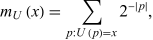 |
where the programs  in the sum are those for which
  eventually halts with output
  . These programs form a prefix-free
code, and
. These programs form a prefix-free
code, and  is the program length. Thus
  is the probability that
a stream of independent random bits begins with a program
that makes
is the probability that
a stream of independent random bits begins with a program
that makes  output
  .
It is a universal lower semicomputable semimeasure.
Changing the universal Turing machine
changes
.
It is a universal lower semicomputable semimeasure.
Changing the universal Turing machine
changes  by at most a multiplicative constant. Algorithmic probability
is closely related to Kolmogorov complexity
through the coding theorem. It gives greater weight to strings
generated by shorter programs, thereby implementing an
Occam-type preference for simpler descriptions in algorithmic induction.
by at most a multiplicative constant. Algorithmic probability
is closely related to Kolmogorov complexity
through the coding theorem. It gives greater weight to strings
generated by shorter programs, thereby implementing an
Occam-type preference for simpler descriptions in algorithmic induction.
