

The Albertson-Berman conjecture asserts that every planar graph on  vertices contains an induced
forest with at least
vertices contains an induced
forest with at least  vertices (Albertson and
Berman 1979). Equivalently, every planar graph would
have a feedback vertex set of size at most
vertices (Albertson and
Berman 1979). Equivalently, every planar graph would
have a feedback vertex set of size at most
 .
.
Cames van Batenburg et al. (2026) proved that the minimum vertex count of a counterexample is 29 and exhibited two such graphs, whose largest induced forests have 14 vertices. They also constructed infinitely many planar graphs with vertex connectivity 4 and edge connectivity 5 that refute the conjecture. The unique smallest counterexample with these connectivity properties has 41 vertices and largest induced forest of size 20.
Writing  for the largest vertex count of an induced
forest of
for the largest vertex count of an induced
forest of  , their infinite family of planar
graphs satisfies
, their infinite family of planar
graphs satisfies
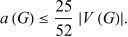 |
Here  is the vertex set. The factor
  improves the factor
  supplied by the 29-vertex counterexamples
(Cames van Batenburg et al. 2026).
supplied by the 29-vertex counterexamples
(Cames van Batenburg et al. 2026).
