


Agoh's conjecture states that, with  denoting the
  th Bernoulli number, the
fractional congruence
th Bernoulli number, the
fractional congruence
 |
holds iff  is prime. Here residues of
fractions are interpreted in the usual way so as to yield integers,
after which the minimal residue is taken. There
are no counterexamples less than
is prime. Here residues of
fractions are interpreted in the usual way so as to yield integers,
after which the minimal residue is taken. There
are no counterexamples less than  (S. Plouffe, pers. comm., Jan. 28, 2003).
Any counterexample to Agoh's conjecture would be a contradiction to Giuga's
conjecture, and vice versa.
(S. Plouffe, pers. comm., Jan. 28, 2003).
Any counterexample to Agoh's conjecture would be a contradiction to Giuga's
conjecture, and vice versa.
A related sequence is defined as follows. Write the Bernoulli number  in lowest terms, and let
  be the denominator in lowest
terms of
be the denominator in lowest
terms of  .
The values of
.
The values of  for
for  ,
2, ... begin 1, 1, 1, 16, 1, 36, 1, 64, 27, 100, ... (OEIS A309132).
For
,
2, ... begin 1, 1, 1, 16, 1, 36, 1, 64, 27, 100, ... (OEIS A309132).
For  ,
the conjecture that
,
the conjecture that  iff
iff  is prime is equivalent to
the Agoh-Giuga conjecture (Adamczewski 2026). This equivalence has an AI-generated
proof formally verified in Lean (Epoch AI 2026).
is prime is equivalent to
the Agoh-Giuga conjecture (Adamczewski 2026). This equivalence has an AI-generated
proof formally verified in Lean (Epoch AI 2026).
For  ,
2, ..., the minimal residues of
,
2, ..., the minimal residues of  (mod
(mod  ) are 0,
  ,
,  , 0,
, 0,  , 0,
, 0,  , 0,
, 0,  , 0,
, 0,  , ... (OEIS A046094).
Kellner (2004) gave a direct proof of the equivalence of Giuga's and Agoh's conjectures. The resulting
Giuga-Agoh conjecture states that, for an integer  ,
,
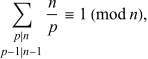 |
holds iff  is prime. Here the sum is
over the prime divisors
is prime. Here the sum is
over the prime divisors  of
of  satisfying
  .
.
