

An additive polynomial over a field  of positive field characteristic
 is a polynomial
 satisfying
 for all
 . The stronger condition that this holds over an algebraic closure of
 is called absolute additivity (Goss 1996). Equivalently, it
is the polynomial identity
 |
(1)
|
in  .
Some authors use "additive polynomial" for this stronger condition (Kuhlmann
2011, pp. 301-302).
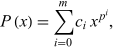
Absolute additivity is equivalent to having the form
 |
(2)
|
where  and
 is a nonnegative integer. In particular, the
Frobenius map
 and its iterates
 are absolutely additive.
The binomial theorem gives this property since
 is divisible by
 for
 (Kuhlmann 2011, p. 302).
Over an infinite field, additivity on  already implies the polynomial
identity. Over a finite field, distinct polynomials
can induce the same polynomial function, so
the two conditions differ. For example, over
 ,
 induces the zero
function, but it is not absolutely additive (Kuhlmann 2011, p. 301).
The absolutely additive polynomials form a ring  under addition
and composition, rather than ordinary polynomial multiplication. A scalar
 acts as the polynomial
 , and
 |
(3)
|
Thus this ring is commutative iff  (Kuhlmann 2011, p. 303).
More generally, suppose  contains the finite field
 , where
 and
 is a positive integer.
The polynomials in
 are precisely those of the form
 . They satisfy
 for every
 over an algebraic
closure, in addition to absolute additivity, and are called
 -linear polynomials (Gow and McGuire 2025, p. 5159).
For a nonzero polynomial  with no multiple
roots, absolute additivity is equivalent to its full set
of roots in an algebraic
closure being a subgroup of the additive group
of that field (Kuhlmann 2011, p. 302). In the absolutely
additive form above,
 , so it has no multiple
root iff
 . Under the same assumption
 , a nonzero polynomial
with no multiple roots is
 -linear iff its full set
of roots in an algebraic
closure is an
 -vector
subspace (Gow and McGuire 2025, pp. 5160-5161).
Here the no-multiple-root condition is essential
and uses the rootwise convention for a separable
polynomial.
