TOPICS
Search

Additive Complement


An additive complement of a set A of nonnegative integers is a set B of nonnegative integers such that the sumset A+B contains all sufficiently large integers. For infinite additive complements, write A(x) and B(x) for the numbers of their elements at most x.

Zhang (2026) gave a discrete proof of the sharp implication

 limsup_(x->infty)(A(x)B(x))/x<3/2==>A(x)B(x)-x->+infty.

The threshold is strict. At equality, examples have A(x)B(x)-x=1 for infinitely many x.

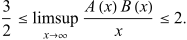
Van Doorn et al. (2026) independently proved the sharp 3/2 obstruction. For infinite additive complements satisfying A(x)B(x)-x↛infty, their result gives

 3/2<=limsup_(x->infty)(A(x)B(x))/x<=2.

Van Doorn et al. (2026) attribute an initial proof to AI and report a Lean formalization checked by the authors.


See also

Additive Number Theory, Sumset

Explore with Wolfram|Alpha

References

van Doorn, W.; Liu, B.; and Tang, Q. "On Almost Perfect Additive Complements." 26 Oct 2026. https://arxiv.org/abs/2610.35027.Zhang, Z. "A Sharp Bound for Additive Complements." 21 Oct 2026. https://arxiv.org/abs/2610.29963.

Cite this as:

Weisstein, Eric W. "Additive Complement." From MathWorld--A Wolfram Resource. https://mathworld.wolfram.com/AdditiveComplement.html

Subject classifications