

An addition chain for a number  is a sequence
  , such that each member after
  is the sum
of two earlier (not necessarily distinct) ones. The number
is the sum
of two earlier (not necessarily distinct) ones. The number  is called the length of the addition chain. For example,
 |
is an addition chain for 14 of length  (Guy 1994).
Let  denote the minimum length of an addition chain for
  , and let
  count the integers
 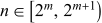 for which
  . De Koninck et al. (2026) proved that for
every fixed
. De Koninck et al. (2026) proved that for
every fixed  ,
there are positive constants
,
there are positive constants  and
and  such that
 |
for all sufficiently large  and all integers
  . Their upper bound also holds for every
integer
. Their upper bound also holds for every
integer  .
.
