

The 68-95-99.7 rule, also called the empirical rule, states that for a normal distribution, approximately 68%, 95%, and 99.7% of the probability
lies within one, two, and three standard deviations
of the mean, respectively. More precisely, if  has mean
  and standard deviation
  , then
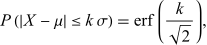 |
for  .
Taking
.
Taking  ,
2, and 3 gives probabilities
,
2, and 3 gives probabilities  (OEIS A178647),
 (OEIS A110894),
and
(OEIS A110894),
and  (OEIS A270712), respectively. The rule is specific
to the normal distribution; it is not a general
statement about arbitrary probability distributions.
(OEIS A270712), respectively. The rule is specific
to the normal distribution; it is not a general
statement about arbitrary probability distributions.
