


The velocity vector of a particle is the time derivative of its position vector. The notion comes from classical
physics. By representing the position and motion of a single particle using vectors,
the equations for motion are simpler and more intuitive. Suppose the position of
a particle at time  is given by the position vector
 . Then the velocity vector
 is the derivative of the
position,
 |

For example, suppose a particle is confined to the plane and its position is given by  . Then it travels along the unit
circle at constant speed. Its velocity vector is
 . In a diagram, it makes
sense to translate the velocity vector so it originates
at
 .
In particular, it is drawn as an arrow from
 to
 .
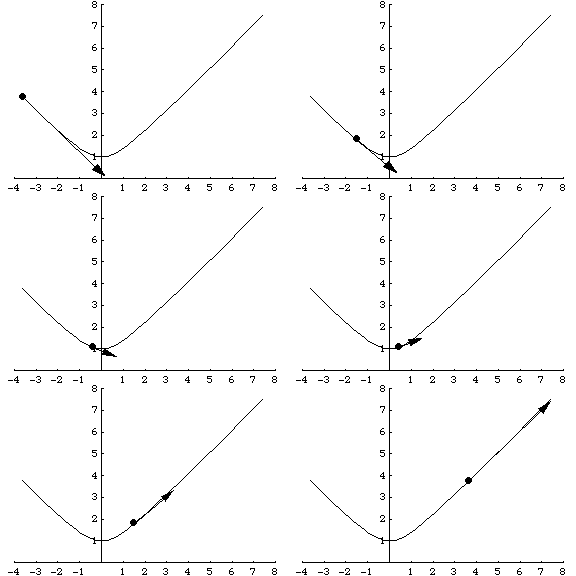
Another example is a particle traveling along a hyperbola specified parametrically by  . Its velocity vector is then given by
 , illustrated above.

Traveling down the same path using a different function is called a reparameterization, and the chain rule describes the change in velocity. For example,
the hyperbola can also be parametrized by  . Note that
 , and by the chain
rule,
 .
Note that the set of possible velocity vectors forms a vector space. If  and
 are two paths through the origin,
then so is
 and the velocity vector of this path is
 . Similarly, if
 is a scalar, then the path
 has velocity vector
 . It makes sense to distinguish the velocity vectors at
different points. In physics, phase
space consists of position and momentum variables. A metric
and a specified mass can identify velocities with momenta in elementary particle
mechanics. In mathematics, the velocity vectors form the tangent
space, and the collection of tangent spaces
forms the tangent bundle.
