


A right strophoid is the strophoid of a line  with pole
  not on
  and fixed point
  being the point where the perpendicular
from
being the point where the perpendicular
from  to
to  cuts
cuts  is called a right strophoid. It is therefore a general strophoid
with
is called a right strophoid. It is therefore a general strophoid
with  .
.
The right strophoid is given by the Cartesian equation
 |
(1)
|
or the polar equation
 |
(2)
|
The parametric form of the strophoid is
 |  |  |
(3)
|
 |  |  |
(4)
|
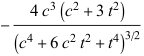
The right strophoid has curvature, arc length, and tangential angle given by
 |  |  |
(5)
|
 |  | ![ikc[(2sqrt(2)-3)E(phi_0,k^2)+2kF(phi_0,k^2)+4Pi(k^2,phi_0,k^2)]](/images/equations/RightStrophoid/Inline20.svg) |
(6)
|
 |  | ![-2tan^(-1)(t/c)+tan^(-1)[((sqrt(2)-1)t)/c]-tan^(-1)[((sqrt(2)+1)t)/c],](/images/equations/RightStrophoid/Inline23.svg) |
(7)
|
where
 |  |  |
(8)
|
 |  |  |
(9)
|
 ,
,  and
and  are incomplete
elliptic integrals of the first, second,
and third kinds, respectively.
are incomplete
elliptic integrals of the first, second,
and third kinds, respectively.
The right strophoid first appears in work by Isaac Barrow in 1670, although Torricelli describes the curve in his letters around 1645 and Roberval found it as the locus of the focus of the conic obtained when the plane cutting the cone rotates about the tangent at its vertex (MacTutor Archive).

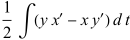
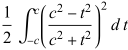
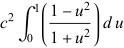
The area of the loop, corresponding to ![t in [-c,c]](/images/equations/RightStrophoid/Inline33.svg) , is given by
, is given by
 |  |  |
(10)
|
 |  |  |
(11)
|
 |  |  |
(12)
|
 |  |  |
(13)
|
(MacTutor Archive). The arc length of the loop is given by
![s=2ikc[(2sqrt(2)-3)E(icsch^(-1)k,k^2)+2kF(icsch^(-1)k,k^2)+4Pi(k^2,icsch^(-1)k,k^2)],](/images/equations/RightStrophoid/NumberedEquation3.svg) |
(14)
|
where  is again defined as above.
Let  be the circle with center at the point where the right
strophoid crosses the x-axis and radius the distance
of that point from the origin. Then the right strophoid is invariant under inversion
in the circle
be the circle with center at the point where the right
strophoid crosses the x-axis and radius the distance
of that point from the origin. Then the right strophoid is invariant under inversion
in the circle  and is therefore an anallagmatic
curve.
and is therefore an anallagmatic
curve.
