The Ramsey number ,
sometimes also denoted
(e.g., Mattheus and Verstraete 2023), gives the solution to the party
problem, which asks the minimum number of guests that must be invited so that at least will know each other or at least will not know each other. In the language of graph
theory, the Ramsey number is the minimum number of vertices such that all undirected simple graphs of order contain a clique
of order or
an independent set of order (i.e., have clique number or independence
number).
Ramsey's theorem states that such a number exists
for all
and .
By symmetry, it is true that
(1)
It also must be true that
(2)
A generalized Ramsey number is written
(3)
and is the smallest integer such that, no matter how each -element subset of an -element set is colored with colors, there exists an such that there is a subset of
size ,
all of whose -element
subsets are color . The usual Ramsey numbers are then equivalent to .
Bounds are given by
(4)
and
(5)
(Chung and Grinstead 1983). Erdős proved that for diagonal Ramsey numbers ,
(6)
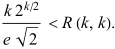
This result was subsequently improved by a factor of 2 by Spencer (1975). was known since 1980 to be bounded from above by , and Griggs (1983) showed that
was an acceptable limit. J.-H.
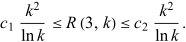
Kim (Cipra 1995) subsequently bounded by a similar expression from below, so
(7)
Burr (1983) gives Ramsey numbers for all 113 graphs with no more than 6 graph
edges and no isolated points.
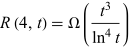
Mattheus and Verstraete (2023) proved that
(8)
as , where is big-omega notation.
This determines
up to a factor of order .
A summary of known results up to 1983 for is given in Chung and Grinstead (1983). Radziszowski
(2021) maintains an up-to-date list of the best current bounds. The numbers whose
exact values are known are summarized below.
Reference
3
3
6
Greenwood
and Gleason (1955)
3
4
9
Greenwood and Gleason (1955)
3
5
14
Greenwood
and Gleason (1955)
3
6
18
Graver and Yackel (1968)
3
7
23
Kalbfleisch
(1966)
3
8
28
McKay and Min (1992)
3
9
36
Grinstead
and Roberts 1982
4
4
18
Greenwood and Gleason (1955)
4
5
25
McKay
and Radziszowski (1995)
Exoo (1989) proved that
and Angeltveit and McKay (2024) proved that , establishing
Angeltveit, V. and McKay, B. D. "." 24 Sep 2024. https://arxiv.org/abs/2409.15709.Burling,
J. P. and Reyner, S. W. "Some Lower Bounds of the Ramsey Numbers ." J. Combin. Th. Ser. B13,
168-169, 1972.Burr, S. A. "Generalized Ramsey Theory for Graphs--A
Survey." In Graphs and Combinatorics (Ed. R. A. Bari and F. Harary).
New York: Springer-Verlag, pp. 52-75, 1974.Burr, S. A. "Diagonal
Ramsey Numbers for Small Graphs." J. Graph Th.7, 57-69, 1983.Burr,
S. A.; Erdős, P.; Faudree, R. J.; and Schelp, R. H. "On
the Difference between Consecutive Ramsey Numbers." Util. Math.35,
115-118, 1989.Chartrand, G. "The Problem of the Eccentric Hosts:
An Introduction to Ramsey Numbers." §5.1 in Introductory
Graph Theory. New York: Dover, pp. 108-115, 1985.Chung,
F. and Grinstead, C. G. "A Survey of Bounds for Classical Ramsey Numbers."
J. Graph. Th.7, 25-37, 1983.Chung, F. R. K.
"On the Ramsey Numbers ." Disc. Math.5, 317-321,
1973.Cipra, B. "A Visit to Asymptopia Yields Insights into Set
Structures." Science267, 964-965, 1995.Exoo, G.
"A Lower Bound for ."
J. Graph Th.13, 97-98, 1989.Exoo, G. "Applying Optimization
Algorithm to Ramsey Problems." In Graph
Theory, Combinatorics, Algorithms, and Applications (Ed. Y. Alavi).
Philadelphia: SIAM, pp. 175-179, 1989a.Exoo, G. "On Two Classical
Ramsey Numbers of the Form ." SIAM J. Discrete Math.2, 488-490,
1989c.Exoo, G. "Announcement: On the Ramsey Numbers , and ." Ars Combin.35, 85, 1993.Exoo,
G. "A Lower Bound for Schur Numbers and Multicolor Ramsey Numbers of ." Elec. J. Combin.1, No. 1, R8,
1-3, 1994. https://doi.org/10.37236/1188.Exoo,
G. "Some New Ramsey Colorings." Elec. J. Combin.5, No. 1,
R29, 1-5, 1998. https://doi.org/10.37236/1367.Exoo,
G. "Some Applications of -Groups in Graph Theory." Preprint. 2002.Folkmann,
J. "Notes on the Ramsey Number ." J. Combinat. Theory. Ser. A16,
371-379, 1974.Fredricksen, H. "Schur Numbers and the Ramsey Numbers
." J. Combin. Theory
Ser. A27, 376-377, 1979.Gardner, M. "Mathematical Games:
In Which Joining Sets of Points by Lines Leads into Diverse (and Diverting) Paths."
Sci. Amer.237, 18-28, 1977.Gardner, M. Penrose
Tiles and Trapdoor Ciphers... and the Return of Dr. Matrix, reissue ed.
New York: W. H. Freeman, pp. 240-241, 1989.Giraud, G. "Une
minoration du nombre de quadrangles unicolores et son application a la majoration
des nombres de Ramsey binaires bicolors." C. R. Acad. Sci. Paris276,
1173-1175, 1973.Graham, R. L.; Rothschild, B. L.; and Spencer,
J. H. Ramsey
Theory, 2nd ed. New York: Wiley, 1990.Graver, J. E. and
Yackel, J. "Some Graph Theoretic Results Associated with Ramsey's Theorem."
J. Combin. Th.4, 125-175, 1968.Greenwood, R. E.
and Gleason, A. M. "Combinatorial Relations and Chromatic Graphs."
Canad. J. Math.7, 1-7, 1955.Griggs, J. R. "An
Upper Bound on the Ramsey Numbers ." J. Comb. Th. A35, 145-153, 1983.Grinstead,
C. M. and Roberts, S. M. "On the Ramsey Numbers and ." J. Combinat. Th. Ser. B33, 27-51,
1982.Guldan, F. and Tomasta, P. "New Lower Bounds of Some Diagonal
Ramsey Numbers." J. Graph. Th.7, 149-151, 1983.Haanpää,
H. "A Lower Bound for a Ramsey Number." Congr. Numer.144,
189-191, 2000.Hanson, D. "Sum-Free Sets and Ramsey Numbers."
Disc. Math.14, 57-61, 1976.Harary, F. "Recent Results
on Generalized Ramsey Theory for Graphs." In Graph
Theory and Applications: Proceedings of the Conference at Western Michigan University,
Kalamazoo, Mich., May 10-13, 1972 (Ed. Y. Alavi, D. R. Lick,
and A. T. White). New York: Springer-Verlag, pp. 125-138, 1972.Harborth,
H. and Krause, S. "Ramsey Numbers for Circulant Colorings." Congr. Numer.161,
139-150, 2003.Hill, R. and Irving, R. W. "On Group Partitions
Associated with Lower Bounds for Symmetric Ramsey Numbers." European J. Combin.3,
35-50, 1982.Hoffman, P. The
Man Who Loved Only Numbers: The Story of Paul Erdős and the Search for Mathematical
Truth. New York: Hyperion, pp. 52-53, 1998.Huang, Y. R.
and Zhang, K. M. "An New Upper Bound Formula for Two Color Classical Ramsey
Numbers." J. Combin. Math. Combin. Comput.28, 347-350, 1998.Kalbfleisch,
J. G. Chromatic Graphs and Ramsey's Theorem. Ph.D. thesis, University
of Waterloo, January 1966.Lesser, A. "Theoretical and Computational
Aspects of Ramsey Theory." Examensarbeten i Matematik, Matematiska Institutionen,
Stockholms Universitet3, 2001.Luo, H.; Su, W.; and Li, Z.
"The Properties of Self-Complementary Graphs and New Lower Bounds for Diagonal
Ramsey Numbers." Australasian J. Combin.25, 103-116, 2002.Luo,
H.; Su, W.; and Shen, Y.-Q. "New Lower Bounds of Ten Classical Ramsey Numbers."
Australasian J. Combin.24, 81-90, 2001.Luo, H.; Su, W.;
Zhang, Z.; and Li, G. "New Lower Bounds for Twelve Classical 2-Color Ramsey
Numbers ."
Guangxi Sci.7, 120-121, 2000.Mackey, J. Combinatorial
Remedies. Ph.D. thesis. Department of Mathematics, University of Hawaii, 1994.Mathon,
R. "Lower Bounds for Ramsey Numbers and Association Schemes." J. Combin.
Th. Ser. B42, 122-127, 1987.Mattheus, S. and Verstraete,
J. "The asymptotics of ." 7 Jun 2023. https://arxiv.org/abs/2306.04007.McKay,
B. D. and Min, Z. K. "The Value of the Ramsey Number ." J. Graph Th.16, 99-105, 1992.McKay,
B. D. and Radziszowski, S. P. "." J. Graph. Th19, 309-322, 1995.Piwakowski,
K. "Applying Tabu Search to Determine New Ramsey Graphs." Elec. J. Combin.3,
No. 1, R6, 1-4, 1996. https://doi.org/10.37236/1230.Radziszowski,
S. and Kreher, D. L. "Search Algorithm for Ramsey Graphs by Union of Group
Orbits." J. Graph Th.12, 59-72, 1988a.Radziszowski,
S. and Kreher, D. L. "Upper Bounds for Some Ramsey Numbers ." J. Combinat. Math. Combin. Comput.4,
207-212, 1988b.Radziszowski, S. P. "Small Ramsey Numbers."
Elec. J. Combin., Dynamic Survey DS1, Apr. 24, 2026. https://doi.org/10.37236/21.Robertson,
A. "New Lower Bounds for Some Multicolored Ramsey Numbers." Elec. J.
Combin.6, No. 1, R3, 1-6, 1999. https://doi.org/10.37236/1435.Shearer,
J. B. "Lower Bounds for Small Diagonal Ramsey Numbers." J. Combin.
Th. Ser. A42, 302-304, 1986.Shi, L. S. "Upper
Bounds for Ramsey Numbers." Preprint. 2002.Shi, L. S. and
Zhang, K. M. "An Upper Bound Formula for Ramsey Numbers" Preprint.
2001.Spencer, J. H. "Ramsey's Theorem--A New Lower Bound."
J. Combinat. Theory Ser. A18, 108-115, 1975.Spencer,
T. "Upper Bounds for Ramsey Numbers via Linear Programming." Preprint.
1994.Su, W.; Luo, H.; Li, G.; and Li, Q. "New Lower Bounds of Classical
Ramsey Numbers ,
, and ." Chinese Sci. Bull.43, 528, 1998.Su,
W.; Luo, H.; Li, G.; and Li, Q. "Lower Bounds of Ramsey Numbers Based on Cubic
Residues." Disc. Math.250, 197-209, 2002.Su, W.;
Luo, H.; Zhang, Z.; and Li, G. "New Lower Bounds of Fifteen Classical Ramsey
Numbers." Australasian J. Combin.19, 91-99, 1999.Wang,
Q. and Wang, G. "New Lower Bounds for the Ramsey Numbers ." Beijing Daxue Xuebao25, 117-121,
1989.Wang, Q.; Wang, G.; and Yan, S. "A Search Algorithm and New
Lower Bounds for Ramsey Numbers ." Preprint. 1994.Whitehead, E. G.
"The Ramsey Number ."
Disc. Math.4, 389-396, 1973.Xiaodong, X. and Zheng, X.
"A Constructive Approach for the Lower Bounds on the Ramsey Numbers ." Unpublished manuscript, 2002.Xiaodong,
X.; Zheng, X.; Exoo, G.; and Radziszowski, S. P. "Constructive Lower Bounds
on Classical Multicolor Ramsey Numbers." Elec. J. Combin.11,
No. 1, R35, 1-24, 2004. https://doi.org/10.37236/1788.


 ,
sometimes also denoted
,
sometimes also denoted  (e.g., Mattheus and Verstraete 2023), gives the solution to the party
problem, which asks the minimum number of guests
(e.g., Mattheus and Verstraete 2023), gives the solution to the party
problem, which asks the minimum number of guests  that must be invited so that at least
  will know each other or at least
  will not know each other. In the language of graph
theory, the Ramsey number is the minimum number of vertices
will not know each other. In the language of graph
theory, the Ramsey number is the minimum number of vertices  such that all undirected simple graphs of order
  contain a clique
of order
contain a clique
of order  or
an independent set of order
or
an independent set of order  (i.e., have clique number
  or independence
number
or independence
number  ).
Ramsey's theorem states that such a number exists
for all
).
Ramsey's theorem states that such a number exists
for all  and
and  .
.



 such that, no matter how each
  -element subset of an
  -element set is colored with
  colors, there exists an
  such that there is a subset of
size
such that there is a subset of
size  ,
all of whose
,
all of whose  -element
subsets are color
-element
subsets are color  . The usual Ramsey numbers are then equivalent to
  .
.


 ,
,
 was known since 1980 to be bounded from above by
  , and Griggs (1983) showed that
 was an acceptable limit. J.-H.
Kim (Cipra 1995) subsequently bounded
was an acceptable limit. J.-H.
Kim (Cipra 1995) subsequently bounded  by a similar expression from below, so
 , where
  is big-omega notation.
This determines
is big-omega notation.
This determines  up to a factor of order
  .
.
 is given in Chung and Grinstead (1983). Radziszowski
(2021) maintains an up-to-date list of the best current bounds. The numbers whose
exact values are known are summarized below.
is given in Chung and Grinstead (1983). Radziszowski
(2021) maintains an up-to-date list of the best current bounds. The numbers whose
exact values are known are summarized below.



 and Angeltveit and McKay (2024) proved that
  , establishing


 ." 24 Sep 2024.
  ." J. Combin. Th. Ser. B 13,
168-169, 1972.Burr, S. A. "Generalized Ramsey Theory for Graphs--A
Survey." In Graphs and Combinatorics (Ed. R. A. Bari and F. Harary).
New York: Springer-Verlag, pp. 52-75, 1974.Burr, S. A. "Diagonal
Ramsey Numbers for Small Graphs." J. Graph Th. 7, 57-69, 1983.Burr,
S. A.; Erdős, P.; Faudree, R. J.; and Schelp, R. H. "On
the Difference between Consecutive Ramsey Numbers." Util. Math. 35,
115-118, 1989.Chartrand, G. "The Problem of the Eccentric Hosts:
An Introduction to Ramsey Numbers." §5.1 in
." J. Combin. Th. Ser. B 13,
168-169, 1972.Burr, S. A. "Generalized Ramsey Theory for Graphs--A
Survey." In Graphs and Combinatorics (Ed. R. A. Bari and F. Harary).
New York: Springer-Verlag, pp. 52-75, 1974.Burr, S. A. "Diagonal
Ramsey Numbers for Small Graphs." J. Graph Th. 7, 57-69, 1983.Burr,
S. A.; Erdős, P.; Faudree, R. J.; and Schelp, R. H. "On
the Difference between Consecutive Ramsey Numbers." Util. Math. 35,
115-118, 1989.Chartrand, G. "The Problem of the Eccentric Hosts:
An Introduction to Ramsey Numbers." §5.1 in  ." Disc. Math. 5, 317-321,
1973.Cipra, B. "A Visit to Asymptopia Yields Insights into Set
Structures." Science 267, 964-965, 1995.Exoo, G.
"A Lower Bound for
." Disc. Math. 5, 317-321,
1973.Cipra, B. "A Visit to Asymptopia Yields Insights into Set
Structures." Science 267, 964-965, 1995.Exoo, G.
"A Lower Bound for  ."
J. Graph Th. 13, 97-98, 1989.Exoo, G. "Applying Optimization
Algorithm to Ramsey Problems." In
."
J. Graph Th. 13, 97-98, 1989.Exoo, G. "Applying Optimization
Algorithm to Ramsey Problems." In  ." SIAM J. Discrete Math. 2, 488-490,
1989c.Exoo, G. "Announcement: On the Ramsey Numbers
." SIAM J. Discrete Math. 2, 488-490,
1989c.Exoo, G. "Announcement: On the Ramsey Numbers  ,
,  and
and  ." Ars Combin. 35, 85, 1993.Exoo,
G. "A Lower Bound for Schur Numbers and Multicolor Ramsey Numbers of
." Ars Combin. 35, 85, 1993.Exoo,
G. "A Lower Bound for Schur Numbers and Multicolor Ramsey Numbers of  ." Elec. J. Combin. 1, No. 1, R8,
1-3, 1994.
." Elec. J. Combin. 1, No. 1, R8,
1-3, 1994.  -Groups in Graph Theory." Preprint. 2002.Folkmann,
J. "Notes on the Ramsey Number
-Groups in Graph Theory." Preprint. 2002.Folkmann,
J. "Notes on the Ramsey Number  ." J. Combinat. Theory. Ser. A 16,
371-379, 1974.Fredricksen, H. "Schur Numbers and the Ramsey Numbers
." J. Combinat. Theory. Ser. A 16,
371-379, 1974.Fredricksen, H. "Schur Numbers and the Ramsey Numbers
 ." J. Combin. Theory
Ser. A 27, 376-377, 1979.Gardner, M. "Mathematical Games:
In Which Joining Sets of Points by Lines Leads into Diverse (and Diverting) Paths."
Sci. Amer. 237, 18-28, 1977.Gardner, M.
." J. Combin. Theory
Ser. A 27, 376-377, 1979.Gardner, M. "Mathematical Games:
In Which Joining Sets of Points by Lines Leads into Diverse (and Diverting) Paths."
Sci. Amer. 237, 18-28, 1977.Gardner, M.  ." J. Comb. Th. A 35, 145-153, 1983.Grinstead,
C. M. and Roberts, S. M. "On the Ramsey Numbers
." J. Comb. Th. A 35, 145-153, 1983.Grinstead,
C. M. and Roberts, S. M. "On the Ramsey Numbers  and
and  ." J. Combinat. Th. Ser. B 33, 27-51,
1982.Guldan, F. and Tomasta, P. "New Lower Bounds of Some Diagonal
Ramsey Numbers." J. Graph. Th. 7, 149-151, 1983.Haanpää,
H. "A Lower Bound for a Ramsey Number." Congr. Numer. 144,
189-191, 2000.Hanson, D. "Sum-Free Sets and Ramsey Numbers."
Disc. Math. 14, 57-61, 1976.Harary, F. "Recent Results
on Generalized Ramsey Theory for Graphs." In
." J. Combinat. Th. Ser. B 33, 27-51,
1982.Guldan, F. and Tomasta, P. "New Lower Bounds of Some Diagonal
Ramsey Numbers." J. Graph. Th. 7, 149-151, 1983.Haanpää,
H. "A Lower Bound for a Ramsey Number." Congr. Numer. 144,
189-191, 2000.Hanson, D. "Sum-Free Sets and Ramsey Numbers."
Disc. Math. 14, 57-61, 1976.Harary, F. "Recent Results
on Generalized Ramsey Theory for Graphs." In  ."
Guangxi Sci. 7, 120-121, 2000.Mackey, J. Combinatorial
Remedies. Ph.D. thesis. Department of Mathematics, University of Hawaii, 1994.Mathon,
R. "Lower Bounds for Ramsey Numbers and Association Schemes." J. Combin.
Th. Ser. B 42, 122-127, 1987.Mattheus, S. and Verstraete,
J. "The asymptotics of
."
Guangxi Sci. 7, 120-121, 2000.Mackey, J. Combinatorial
Remedies. Ph.D. thesis. Department of Mathematics, University of Hawaii, 1994.Mathon,
R. "Lower Bounds for Ramsey Numbers and Association Schemes." J. Combin.
Th. Ser. B 42, 122-127, 1987.Mattheus, S. and Verstraete,
J. "The asymptotics of  ." 7 Jun 2023.
  ." J. Graph Th. 16, 99-105, 1992.McKay,
B. D. and Radziszowski, S. P. "
." J. Graph Th. 16, 99-105, 1992.McKay,
B. D. and Radziszowski, S. P. " ." J. Graph. Th 19, 309-322, 1995.Piwakowski,
K. "Applying Tabu Search to Determine New Ramsey Graphs." Elec. J. Combin. 3,
No. 1, R6, 1-4, 1996.
." J. Graph. Th 19, 309-322, 1995.Piwakowski,
K. "Applying Tabu Search to Determine New Ramsey Graphs." Elec. J. Combin. 3,
No. 1, R6, 1-4, 1996.  ." J. Combinat. Math. Combin. Comput. 4,
207-212, 1988b.Radziszowski, S. P. "Small Ramsey Numbers."
Elec. J. Combin., Dynamic Survey DS1, Apr. 24, 2026.
." J. Combinat. Math. Combin. Comput. 4,
207-212, 1988b.Radziszowski, S. P. "Small Ramsey Numbers."
Elec. J. Combin., Dynamic Survey DS1, Apr. 24, 2026.  ,
,
 , and
, and  ." Chinese Sci. Bull. 43, 528, 1998.Su,
W.; Luo, H.; Li, G.; and Li, Q. "Lower Bounds of Ramsey Numbers Based on Cubic
Residues." Disc. Math. 250, 197-209, 2002.Su, W.;
Luo, H.; Zhang, Z.; and Li, G. "New Lower Bounds of Fifteen Classical Ramsey
Numbers." Australasian J. Combin. 19, 91-99, 1999.Wang,
Q. and Wang, G. "New Lower Bounds for the Ramsey Numbers
." Chinese Sci. Bull. 43, 528, 1998.Su,
W.; Luo, H.; Li, G.; and Li, Q. "Lower Bounds of Ramsey Numbers Based on Cubic
Residues." Disc. Math. 250, 197-209, 2002.Su, W.;
Luo, H.; Zhang, Z.; and Li, G. "New Lower Bounds of Fifteen Classical Ramsey
Numbers." Australasian J. Combin. 19, 91-99, 1999.Wang,
Q. and Wang, G. "New Lower Bounds for the Ramsey Numbers  ." Beijing Daxue Xuebao 25, 117-121,
1989.Wang, Q.; Wang, G.; and Yan, S. "A Search Algorithm and New
Lower Bounds for Ramsey Numbers
." Beijing Daxue Xuebao 25, 117-121,
1989.Wang, Q.; Wang, G.; and Yan, S. "A Search Algorithm and New
Lower Bounds for Ramsey Numbers  ." Preprint. 1994.Whitehead, E. G.
"The Ramsey Number
." Preprint. 1994.Whitehead, E. G.
"The Ramsey Number  ."
Disc. Math. 4, 389-396, 1973.Xiaodong, X. and Zheng, X.
"A Constructive Approach for the Lower Bounds on the Ramsey Numbers
."
Disc. Math. 4, 389-396, 1973.Xiaodong, X. and Zheng, X.
"A Constructive Approach for the Lower Bounds on the Ramsey Numbers  ." Unpublished manuscript, 2002.Xiaodong,
X.; Zheng, X.; Exoo, G.; and Radziszowski, S. P. "Constructive Lower Bounds
on Classical Multicolor Ramsey Numbers." Elec. J. Combin. 11,
No. 1, R35, 1-24, 2004.
." Unpublished manuscript, 2002.Xiaodong,
X.; Zheng, X.; Exoo, G.; and Radziszowski, S. P. "Constructive Lower Bounds
on Classical Multicolor Ramsey Numbers." Elec. J. Combin. 11,
No. 1, R35, 1-24, 2004.