


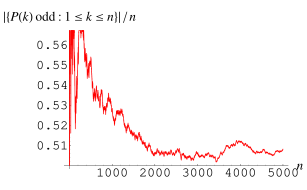
The fraction of odd values of the partition function P(n) is roughly 50%, independent of  , whereas odd values of
  occur with ever decreasing frequency as
  becomes large. Kolberg (1959) proved that there are infinitely
many even and odd values of
becomes large. Kolberg (1959) proved that there are infinitely
many even and odd values of  .
.
Leibniz noted that  is prime for
  , 3, 4, 5, 6, but not 7. In fact, values of
  for which
  is prime are 2, 3, 4, 5,
6, 13, 36, 77, 132, 157, 168, 186, ... (OEIS A046063),
corresponding to 2, 3, 5, 7, 11, 101, 17977, 10619863, ... (OEIS A049575).
Numbers which cannot be written as a product of
is prime are 2, 3, 4, 5,
6, 13, 36, 77, 132, 157, 168, 186, ... (OEIS A046063),
corresponding to 2, 3, 5, 7, 11, 101, 17977, 10619863, ... (OEIS A049575).
Numbers which cannot be written as a product of  are 13, 17, 19, 23, 26, 29, 31, 34, 37, 38, 39, ... (OEIS A046064),
corresponding to numbers of nonisomorphic Abelian groups
which are not possible for any group order.
are 13, 17, 19, 23, 26, 29, 31, 34, 37, 38, 39, ... (OEIS A046064),
corresponding to numbers of nonisomorphic Abelian groups
which are not possible for any group order.
Ramanujan conjectured a number of amazing and unexpected congruences involving  . In particular, he proved
 |
(1)
|
using Ramanujan's identity (Darling 1919; Hardy and Wright 1979; Drost 1997; Hardy 1999, pp. 87-88; Hirschhorn 1999). Ramanujan (1919) also showed that
 |
(2)
|
and Krečmar (1933) proved that
 |
(3)
|
Watson (1938) then proved the general congruence
 |
(4)
|
(Gordon and Hughes 1981; Hardy 1999, p. 89). For  , 2, ..., the corresponding minimal values of
  are 4, 24, 99, 599, 2474, 14974, 61849, ... (OEIS A052463).
However, the even more general congruences
are 4, 24, 99, 599, 2474, 14974, 61849, ... (OEIS A052463).
However, the even more general congruences
 |
(5)
|
 |
(6)
|
seem also to hold.
Ramanujan showed that
 |
(7)
|
(Darling 1919), which can be derived using the Euler identity and Jacobi triple product (Hardy 1999, pp. 87-88), and also that
 |
(8)
|
(Hardy 1999, p. 90). He conjectured that in general
![P(n)=0 (mod 7^b) if 24n=1 (mod 7^b) [incorrect]](/images/equations/PartitionFunctionPCongruences/NumberedEquation9.svg) |
(9)
|
(Gordon and Hughes 1981, Hardy 1999), although Gupta (1936) showed that this is false when  .
Watson (1938) subsequently formulated and proved the modified relation
.
Watson (1938) subsequently formulated and proved the modified relation
 |
(10)
|
for  .
For
.
For  ,
2, ..., the corresponding minimal values of
,
2, ..., the corresponding minimal values of  are 0, 47, 2301, 112747, ... (OEIS A052464).
However, the even more general congruences
are 0, 47, 2301, 112747, ... (OEIS A052464).
However, the even more general congruences
 |
(11)
|
appear to hold.
Ramanujan showed that
 |
(12)
|
holds (Gordon and Hughes 1981; Hardy 1999, pp. 87-88), and conjectured the general relation
 |
(13)
|
This was finally proved by Atkin (1967). For  , 2, ..., the corresponding minimal values of
  are 6, 116, 721, 14031, ... (OEIS A052465).
Atkin and O'Brien (1967) proved
 |
(14)
|
where  is an integer depending only on
  (Gordon and Hughes 1981). For
  , 2, ..., the corresponding minimal values of
  are 6, 162, 1007, 27371, ... (OEIS A052466).
Subbarao (1966) conjectured that in every arithmetic progression  (mod
(mod  ), there are infinitely many integers
  for which
  is even, and infinitely
many integer
is even, and infinitely
many integer  for which
  is odd.
Dyson (1944) explained congruences modulo 5 and 7 via a mathematical tool he termed a "rank" and conjectured that this approach could be extended to other moduli. The conjecture (sometimes known as the "crank conjecture") was extended to congruences modulo 11 (Andrews and Garvan 1988). Mahlburg (2005) subsequently completely resolved the conjecture with an elegant proof described by Dyson as "beautiful and totally unexpected."
In the Season 4 opening episode "Trust Metric" (2007) of the television crime drama NUMB3RS, math genius Charlie Eppes closes the opening scene by informing his class they will cover partition congruences in the next class (despite the strange fact that the current lesson was on Nash equilibria).

 and
and  Modulo Powers of 13." Trans. Amer. Math. Soc. 126,
442-459, 1967.Chowla, S. "Congruence Properties of Partitions."
J. London Math. Soc. 9, 247, 1934.Darling, H. B. C.
"On Mr. Ramanujan's Congruence Properties of
Modulo Powers of 13." Trans. Amer. Math. Soc. 126,
442-459, 1967.Chowla, S. "Congruence Properties of Partitions."
J. London Math. Soc. 9, 247, 1934.Darling, H. B. C.
"On Mr. Ramanujan's Congruence Properties of  ." Proc. Cambridge Philos. Soc. 19, 217-218,
1919.Darling, H. B. C. "Proofs of Certain Identities
and Congruences Enunciated by S. Ramanujan." Proc. London Math. Soc. 19,
350-372, 1921.Drost, J. L. "A Shorter Proof of the Ramanujan
Congruence mod 5." Amer. Math. Monthly 104, 963-964, 1997.Dyson,
F. J. Eureka 8, 10-15, 1944.Dyson, F. J. "Mappings
and Symmetries of Partitions." J. Combin. Theory Ser. A 51, 169-180,
1989.Folsom, A.; Kent, Z. A.;and Ono, K. "
." Proc. Cambridge Philos. Soc. 19, 217-218,
1919.Darling, H. B. C. "Proofs of Certain Identities
and Congruences Enunciated by S. Ramanujan." Proc. London Math. Soc. 19,
350-372, 1921.Drost, J. L. "A Shorter Proof of the Ramanujan
Congruence mod 5." Amer. Math. Monthly 104, 963-964, 1997.Dyson,
F. J. Eureka 8, 10-15, 1944.Dyson, F. J. "Mappings
and Symmetries of Partitions." J. Combin. Theory Ser. A 51, 169-180,
1989.Folsom, A.; Kent, Z. A.;and Ono, K. " -adic Properties of the Partition Function."
  ." In
." In  ."
Ann. Math. 151, 293-307, 2000.Ramanujan, S. "Some
Properties of
."
Ann. Math. 151, 293-307, 2000.Ramanujan, S. "Some
Properties of  , the Number of Partitions of
  ." Proc. Cambridge Philos. Soc. 19, 207-210,
1919.Ramanujan, S. "Congruence Properties of Partitions."
Math. Z. 9, 147-153, 1921.Sloane, N. J. A. Sequences
." Proc. Cambridge Philos. Soc. 19, 207-210,
1919.Ramanujan, S. "Congruence Properties of Partitions."
Math. Z. 9, 147-153, 1921.Sloane, N. J. A. Sequences
 ." J. Combin. Th. 6, 56-59,
1969.
." J. Combin. Th. 6, 56-59,
1969.