


An Abelian group is a group for which the elements commute (i.e.,  for all elements
  and
and  ). Abelian groups therefore correspond
to groups with symmetric multiplication
tables.
). Abelian groups therefore correspond
to groups with symmetric multiplication
tables.
All cyclic groups are Abelian, but an Abelian group is not necessarily cyclic. All subgroups of an Abelian group are normal. In an Abelian group, each element is in a conjugacy class by itself, and the character table involves powers of a single element known as a group generator.
In the Wolfram Language, the function AbelianGroup[ n1, n2, ...
 ] represents the direct product of the cyclic groups of degrees
 ,
,  , ....
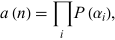
No general formula is known for giving the number of nonisomorphic finite groups of a given group order. However, the number
of nonisomorphic Abelian finite groups  of any given group order
  is given by writing
  as
as
 |
(1)
|
where the  are distinct prime factors, then
 |
(2)
|
where  is the partition function, which is implemented
in the Wolfram Language as FiniteAbelianGroupCount[n].
The values of
is the partition function, which is implemented
in the Wolfram Language as FiniteAbelianGroupCount[n].
The values of  for
for  ,
2, ... are 1, 1, 1, 2, 1, 1, 1, 3, 2, ... (OEIS A000688).
,
2, ... are 1, 1, 1, 2, 1, 1, 1, 3, 2, ... (OEIS A000688).
The smallest orders for which  , 2, 3, ... nonisomorphic Abelian groups exist are 1, 4,
8, 36, 16, 72, 32, 900, 216, 144, 64, 1800, 0, 288, 128, ... (OEIS A046056),
where 0 denotes an impossible number (i.e., not a product of partition numbers) of
nonisomorphic Abelian, groups. The "missing" values are 13, 17, 19, 23,
26, 29, 31, 34, 37, 38, 39, 41, 43, 46, ... (OEIS A046064).
The incrementally largest numbers of Abelian groups as a function of order are 1,
2, 3, 5, 7, 11, 15, 22, 30, 42, 56, 77, 101, ... (OEIS A046054),
which occur for orders 1, 4, 8, 16, 32, 64, 128, 256, 512, 1024, 2048, 4096, 8192,
... (OEIS A046055).
, 2, 3, ... nonisomorphic Abelian groups exist are 1, 4,
8, 36, 16, 72, 32, 900, 216, 144, 64, 1800, 0, 288, 128, ... (OEIS A046056),
where 0 denotes an impossible number (i.e., not a product of partition numbers) of
nonisomorphic Abelian, groups. The "missing" values are 13, 17, 19, 23,
26, 29, 31, 34, 37, 38, 39, 41, 43, 46, ... (OEIS A046064).
The incrementally largest numbers of Abelian groups as a function of order are 1,
2, 3, 5, 7, 11, 15, 22, 30, 42, 56, 77, 101, ... (OEIS A046054),
which occur for orders 1, 4, 8, 16, 32, 64, 128, 256, 512, 1024, 2048, 4096, 8192,
... (OEIS A046055).
The Kronecker decomposition theorem states that every finite Abelian group can be written
as a group direct product of cyclic
groups of prime power group order. If the group
order of a finite group is a prime  , then there exists a single Abelian
group of order
, then there exists a single Abelian
group of order  (denoted
  )
and no non-Abelian groups. If the group order is a
prime squared
)
and no non-Abelian groups. If the group order is a
prime squared  ,
then there are two Abelian groups (denoted
,
then there are two Abelian groups (denoted  and
and  ). If the group order
is a prime cubed
). If the group order
is a prime cubed  ,
then there are three Abelian groups (denoted
,
then there are three Abelian groups (denoted 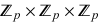 ,
,  , and
, and  ), and five groups total. If the order is a product
of two primes
), and five groups total. If the order is a product
of two primes  and
and  ,
then there exists exactly one Abelian group of group order
,
then there exists exactly one Abelian group of group order  (denoted
  ).
).
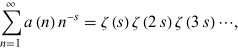
Another interesting result is that if  denotes the number of nonisomorphic Abelian groups of group order
  , then
 |
(3)
|
where  is the Riemann zeta function.
The numbers of Abelian groups of orders  are given by 1, 2, 3, 5, 6, 7, 8, 11, 13, 14, 15, 17,
18, 19, 20, 25, ... (OEIS A063966) for
are given by 1, 2, 3, 5, 6, 7, 8, 11, 13, 14, 15, 17,
18, 19, 20, 25, ... (OEIS A063966) for  , 2, .... Srinivasan (1973) has also
shown that
, 2, .... Srinivasan (1973) has also
shown that
![sum_(n=1)^Na(n)=A_1N+A_2N^(1/2)+A_3N^(1/3)+O[N^(105/407)(lnN)^2],](/images/equations/AbelianGroup/NumberedEquation4.svg) |
(4)
|
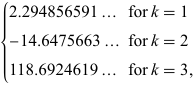
where
 |  |  |
(5)
|
 |  |  |
(6)
|
(OEIS A021002, A084892, and A084893) and  is again the Riemann
zeta function. Note that Richert (1952) incorrectly gave
is again the Riemann
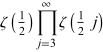
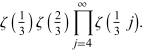
zeta function. Note that Richert (1952) incorrectly gave  . The sums
  can also be written in the explicit forms
 |  |  |
(7)
|
 |  |  |
(8)
|
 |  |  |
(9)
|
DeKoninck and Ivic (1980) showed that
![sum_(n=1)^N1/(a(n))=BN+O[sqrt(N)(lnN)^(-1/2)],](/images/equations/AbelianGroup/NumberedEquation5.svg) |
(10)
|
where
 |  | ![product_(p){1-sum_(k=2)^(infty)[1/(P(k-1))-1/(P(k))]1/(p^k)}](/images/equations/AbelianGroup/Inline55.svg) |
(11)
|
 |  |  |
(12)
|
(OEIS A084911) is a product over primes  and
and  is again the partition
function.
is again the partition
function.
Bounds for the number of nonisomorphic non-Abelian groups are given by Neumann (1969) and Pyber (1993).
There are a number of mathematical jokes involving Abelian groups (Renteln and Dundes 2005):
Q: What's purple and commutes? A: An Abelian grape.
Q: What is lavender and commutes? A: An Abelian semigrape.
Q: What's purple, commutes, and is worshipped by a limited number of people? A: A finitely-venerated Abelian grape.
Q: What's nutritious and commutes? A: An Abelian soup.
