The exponent grows greater by for each increase in of 1. It is given by
(31)
Therefore,
(32)
This means that
(33)
The coefficient must be determined by going back to (◇) and (◇)
and letting .
Then
(34)
(35)
(36)
(37)
(38)
since multiplication is associative. It is clear from this expression that the term must be 1, because all other terms will contain higher
powers of . Therefore,
Andrews, G. E. q-Series: Their Development and Application in Analysis, Number Theory, Combinatorics, Physics,
and Computer Algebra. Providence, RI: Amer. Math. Soc., pp. 63-64, 1986.Bailey,
D. H.; Borwein, J. M.; Calkin, N. J.; Girgensohn, R.; Luke, D. R.;
and Moll, V. H. Experimental
Mathematics in Action. Wellesley, MA: A K Peters, p. 222, 2007.Berndt,
B. C.; Huang, S.-S.; Sohn, J.; and Son, S. H. "Some Theorems on the
Rogers-Ramanujan Continued Fraction in Ramanujan's Lost Notebook." Trans.
Amer. Math. Soc.352, 2157-2177, 2000.Borwein, J. M.
and Borwein, P. B. "Jacobi's Triple Product and Some Number Theoretic Applications."
Ch. 3 in Pi
& the AGM: A Study in Analytic Number Theory and Computational Complexity.
New York: Wiley, pp. 62-101, 1987.Foata, D. and Han, G.-N. "The
Triple, Quintuple and Septuple Product Identities Revisited." In The Andrews
Festschrift (Maratea, 1998): Papers from the Seminar in Honor of George Andrews on
the Occasion of His 60th Birthday Held in Maratea, August 31-September 6, 1998.Sém.
Lothar. Combin.42, Art. B42o, 1-12, 1999 (electronic).Gasper,
G. and Rahman, M. Basic
Hypergeometric Series. Cambridge, England: Cambridge University Press, 1990.Hardy,
G. H. Ramanujan:
Twelve Lectures on Subjects Suggested by His Life and Work, 3rd ed. New York:
Chelsea, 1999.Hardy, G. H. and Wright, E. M. An
Introduction to the Theory of Numbers, 5th ed. Oxford, England: Clarendon
Press, 1979.Hirschhorn, M. D. "Another Short Proof of Ramanujan's
Mod 5 Partition Congruences, and More." Amer. Math. Monthly106,
580-583, 1999.Jacobi, C. G. J. Fundamenta Nova Theoriae
Functionum Ellipticarum. Königsberg, Germany: Regiomonti, Sumtibus fratrum
Borntraeger, p. 90, 1829.Leininger, V. E. and Milne, S. C.
"Expansions for and Basic Hypergeometric Series in ." Discr. Math.204, 281-317, 1999.Whittaker,
E. T. and Watson, G. N. A
Course in Modern Analysis, 4th ed. Cambridge, England: Cambridge University
Press, p. 470, 1990.





 and
and  (Gasper and Rahman 1990, p. 12; Leininger and Milne 1999). Another form of the
identity is
(Gasper and Rahman 1990, p. 12; Leininger and Milne 1999). Another form of the
identity is

 and letting
  gives the limiting case


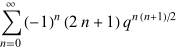


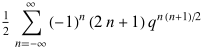
 , (◇) becomes


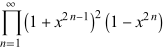


 is a Jacobi elliptic function. In terms
of the two-variable Ramanujan theta function
is a Jacobi elliptic function. In terms
of the two-variable Ramanujan theta function  , the Jacobi triple product is equivalent
to
, the Jacobi triple product is equivalent
to



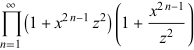






 (
(

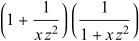


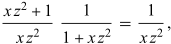

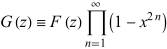
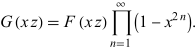


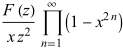



 in a Laurent series. Since
  is an even function, the
Laurent series contains only even terms.
is an even function, the
Laurent series contains only even terms.
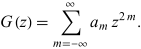


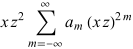


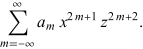
 on the left side of (25)
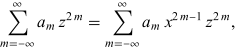







 for each increase in
  of 1. It is given by


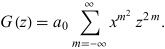
 must be determined by going back to (◇) and (◇)
and letting
must be determined by going back to (◇) and (◇)
and letting  .
Then
.
Then


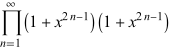


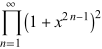


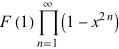


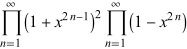


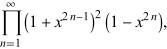
 term must be 1, because all other terms will contain higher
powers of
term must be 1, because all other terms will contain higher
powers of  . Therefore,






 and Basic Hypergeometric Series in
  ." Discr. Math. 204, 281-317, 1999.Whittaker,
E. T. and Watson, G. N.
." Discr. Math. 204, 281-317, 1999.Whittaker,
E. T. and Watson, G. N.