


A hyperboloid is a quadratic surface which may be one- or two-sheeted. The one-sheeted hyperboloid is a surface of revolution obtained by rotating a hyperbola about the perpendicular bisector to the line between the foci (Hilbert and Cohn-Vossen 1991, p. 11).
A hyperboloid of one sheet is also obtained as the envelope of a cube rotated about a space diagonal (Steinhaus 1999, pp. 171-172). Three skew lines always define a one-sheeted hyperboloid, except in the case where they are all parallel to a single plane but not to each other (Hilbert and Cohn-Vossen 1999, p. 15).
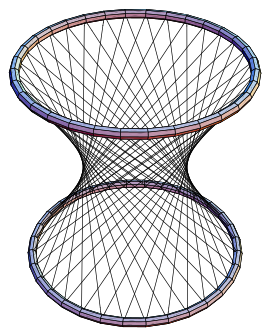
The hyperboloid of one sheet can be constructed by connecting two concentric vertically offset rings with tilted wires, as illustrated above (Steinhaus 1999, pp. 242-243; Hilbert and Cohn-Vossen 1999, p. 11). Surprisingly, when the wires are fastened together so that rotation but not sliding is permitted, the framework can be expanded and collapsed as one ring is rotated relative to the other (Hilbert and Cohn-Vossen 1999, pp. 16-17 and 29-31).
|
|
|
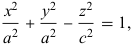
The one-sheeted circular hyperboloid is a doubly ruled surface. When oriented along the z-axis,
the one-sheeted circular hyperboloid with skirt radius  has Cartesian equation
 |
(1)
|
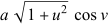
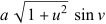
and parametric equation
 |  |  |
(2)
|
 |  |  |
(3)
|
 |  |  |
(4)
|
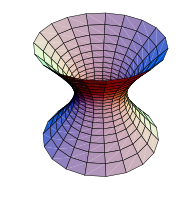
for  (left figure).
An obvious generalization gives the one-sheeted elliptic hyperboloid.
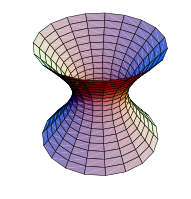
Other parameterizations include
 |  |  |
(5)
|
 |  |  |
(6)
|
 |  |  |
(7)
|
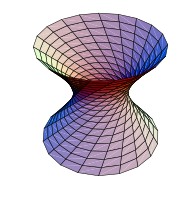
(middle figure), or
 |  |  |
(8)
|
 |  |  |
(9)
|
 |  |  |
(10)
|
(right figure).
The coefficients of the first fundamental form of the first parametrization are given by
 |  |  |
(11)
|
 |  |  |
(12)
|
 |  |  |
(13)
|
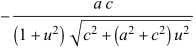
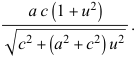
and the coefficients of the second fundamental form by
 |  |  |
(14)
|
 |  |  |
(15)
|
 |  |  |
(16)
|
The Gaussian and mean curvatures are given by
 |  | ![-(c^2)/([c^2+(a^2+c^2)u^2]^2)](/images/equations/One-SheetedHyperboloid/Inline50.svg) |
(17)
|
 |  | ![(c^2[a^2(u^2-1)+c^2(u^2+1)])/(2a[c^2+(a^2+c^2)u^2]^(3/2)),](/images/equations/One-SheetedHyperboloid/Inline53.svg) |
(18)
|
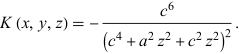
and the Gaussian curvature can be expressed implicitly as
 |
(19)
|
The surface area of a one-sheeted hyperboloid of half-height  with parameters
  and
and  is therefore
![S=2pia[(hsqrt(h^2(a^2+c^2)+4c^4))/(4c^2)+(c^2sinh^(-1)((hsqrt(a^2+c^2))/(2c^2)))/(sqrt(a^2+c^2))],](/images/equations/One-SheetedHyperboloid/NumberedEquation3.svg) |
(20)
|
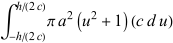
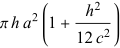
and the volume is given by
 |  |  |
(21)
|
 |  |  |
(22)
|
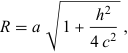
(Harris and Stocker 1998, p. 112). Letting  be the radius of the top cross section gives
 |
(23)
|
so the volume can be re-expressed as
 |
(24)
|
(Harris and Stocker 1998, p. 112).
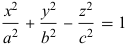
The support function of the hyperboloid of one sheet
 |
(25)
|
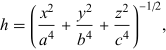
is
 |
(26)
|
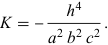
and the Gaussian curvature is
 |
(27)
|
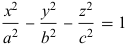
The support function of the hyperboloid of two sheets
 |
(28)
|
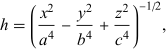
is
 |
(29)
|
and the Gaussian curvature is
 |
(30)
|
(Gray 1997, p. 414).
