

A quadratic surface is a second-order algebraic surface given by the general equation
 |
(1)
|
Quadratic surfaces are also called quadrics, and there are 17 standard-form types. A quadratic surface intersects every plane in a (proper or degenerate) conic section. In addition, the cone consisting of all tangents from a fixed point to a quadratic surface cuts every plane in a conic section, and the points of contact of this cone with the surface form a conic section (Hilbert and Cohn-Vossen 1999, p. 12).
Examples of quadratic surfaces include the cone, cylinder, ellipsoid, elliptic cone, elliptic cylinder, elliptic hyperboloid, elliptic paraboloid, hyperbolic cylinder, hyperbolic paraboloid, paraboloid, sphere, and spheroid.
Define
 |  | ![[a h g; h b f; g f c]](/images/equations/QuadraticSurface/Inline3.svg) |
(2)
|
 |  | ![[a h g p; h b f q; g f c r; p q r d]](/images/equations/QuadraticSurface/Inline6.svg) |
(3)
|
 |  |  |
(4)
|
 |  |  |
(5)
|
 |  |  |
(6)
|
and let  ,
,
 ,
and
,
and  be the eigenvalues of
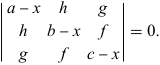
  , namely the roots of
 |
(7)
|
Also define
 |
(8)
|
For a centered homogeneous quadratic surface  with nonsingular real symmetric
matrix
with nonsingular real symmetric
matrix  ,
an orthogonal transformation diagonalizes
,
an orthogonal transformation diagonalizes
 .
If
.
If  ,
,
 ,
and
,
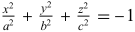
and  all have the same sign, the only real solution is the origin and the surface is an
imaginary elliptic cone. If the eigenvalues have mixed
signs, there are nonzero real solutions and the surface is a real elliptic
cone. Thus this distinction is determined by the matrix
signature, or equivalently by the signs of the eigenvalues.
The same criterion is used for quadratic boundaries arising in band-structure models
(Wei et al. 2026).
all have the same sign, the only real solution is the origin and the surface is an
imaginary elliptic cone. If the eigenvalues have mixed
signs, there are nonzero real solutions and the surface is a real elliptic
cone. Thus this distinction is determined by the matrix
signature, or equivalently by the signs of the eigenvalues.
The same criterion is used for quadratic boundaries arising in band-structure models
(Wei et al. 2026).
Then the following table enumerates the 17 quadrics and their properties (Beyer 1987).
| surface | equation | 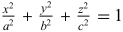 |  | 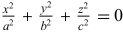 | 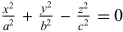 |
| coincident planes |  | 1 | 1 | ||
| ellipsoid (imaginary) |  | 3 | 4 |  | 1 |
| ellipsoid (real) |  | 3 | 4 |  | 1 |
| elliptic cone (imaginary) |  | 3 | 3 | 1 | |
| elliptic cone (real) |  | 3 | 3 | 0 | |
| elliptic cylinder (imaginary) | 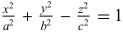 | 2 | 3 | 1 | |
| elliptic cylinder (real) |  | 2 | 3 | 1 | |
| elliptic paraboloid | 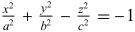 | 2 | 4 |  | 1 |
| hyperbolic cylinder |  | 2 | 3 | 0 | |
| hyperbolic paraboloid |  | 2 | 4 |  | 0 |
| hyperboloid of one sheet |  | 3 | 4 |  | 0 |
| hyperboloid of two sheets |  | 3 | 4 |  | 0 |
| intersecting planes (imaginary) |  | 2 | 2 | 1 | |
| intersecting planes (real) |  | 2 | 2 | 0 | |
| parabolic cylinder |  | 1 | 3 | ||
| parallel planes (imaginary) |  | 1 | 2 | ||
| parallel planes (real) |  | 1 | 2 |
Of the non-degenerate quadratic surfaces, the elliptic (and usual) cylinder, hyperbolic cylinder, elliptic (and usual) cone are ruled surfaces, while the one-sheeted hyperboloid and hyperbolic paraboloid are doubly ruled surfaces.
A curve in which two arbitrary quadratic surfaces in arbitrary positions intersect cannot meet any plane in more than four points (Hilbert and Cohn-Vossen 1999, p. 24).
