

An elliptic partial differential equation given by
 |
(1)
|
where  is a scalar function and
  is the scalar Laplacian,
or
is the scalar Laplacian,
or
 |
(2)
|
where  is a vector function and
  is the vector Laplacian (Moon and Spencer 1988, pp. 136-143).
When  ,
the Helmholtz differential equation reduces to Laplace's
equation. When
,
the Helmholtz differential equation reduces to Laplace's
equation. When  (i.e., for imaginary
  ), the equation becomes the space part of the diffusion equation.
The Helmholtz differential equation can be solved by separation of variables in only 11 coordinate systems, 10 of which (with the exception of
confocal paraboloidal coordinates)
are particular cases of the confocal
ellipsoidal system: Cartesian, confocal
ellipsoidal, confocal paraboloidal,
conical, cylindrical,
elliptic cylindrical, oblate
spheroidal, paraboloidal, parabolic
cylindrical, prolate spheroidal,
and spherical coordinates (Eisenhart 1934ab).
Laplace's equation (the Helmholtz differential
equation with  ) is separable in the two additional bispherical
coordinates and toroidal coordinates.
) is separable in the two additional bispherical
coordinates and toroidal coordinates.
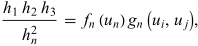
If Helmholtz's equation is separable in a three-dimensional coordinate system, then Morse and Feshbach (1953, pp. 509-510) show that
 |
(3)
|
where  .
The Laplacian is therefore of
the form
.
The Laplacian is therefore of
the form
![del ^2=1/(h_1h_2h_3){g_1(u_2,u_3)partial/(partialu_1)[f_1(u_1)partial/(partialu_1)]+g_2(u_1,u_3)partial/(partialu_2)[f_2(u_2)partial/(partialu_2)]+g_3(u_1,u_2)partial/(partialu_3)[f_3(u_3)partial/(partialu_3)]},](/images/equations/HelmholtzDifferentialEquation/NumberedEquation4.svg) |
(4)
|
which simplifies to
![del ^2=1/(h_1^2f_1)partial/(partialu_1)[f_1(u_1)partial/(partialu_1)]+1/(h_2^2f_2)partial/(partialu_2)[f_2(u_2)partial/(partialu_2)]+1/(h_3^2f_3)partial/(partialu_3)[f_3(u_3)partial/(partialu_3)].](/images/equations/HelmholtzDifferentialEquation/NumberedEquation5.svg) |
(5)
|
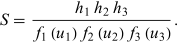
Such a coordinate system obeys the Robertson condition, which means that the Stäckel determinant is of the form
 |
(6)
|
