


The Dirac matrices, also called gamma matrices or Dirac gamma matrices, in four spacetime dimensions are four  complex matrices
  satisfying the anticommutator
relations
satisfying the anticommutator
relations
 |
(1)
|
where  and
and  range over 0, 1, 2, 3, and the diagonal matrix
  fixes the metric
signature convention. Here
fixes the metric
signature convention. Here  denotes the
  identity matrix,
and
identity matrix,
and  .
These relations give a representation of a Clifford
algebra and imply
.
These relations give a representation of a Clifford
algebra and imply  and
and  for
for  ,
2, 3. The matrices arise in the relativistic Dirac
equation (Good 1955, Tong).
,
2, 3. The matrices arise in the relativistic Dirac
equation (Good 1955, Tong).
The name is also used for related collections, including four Hermitian matrices  ,
,
 ,
,  ,
,  , a five-element extension of this set, and a 16-element
vector basis for all
, a five-element extension of this set, and a 16-element
vector basis for all  complex matrices.
These counts refer to different collections, not to different numbers of spacetime
gamma matrices.
complex matrices.
These counts refer to different collections, not to different numbers of spacetime
gamma matrices.
A useful construction starts with six auxiliary  matrices,
 |  |  |
(2)
|
 |  |  |
(3)
|
where  are the
  Pauli matrices,
  , 2, 3, and
  is the Kronecker
product. The six auxiliary matrices, together with
the identity matrix, give the following seven
matrices.
is the Kronecker
product. The six auxiliary matrices, together with
the identity matrix, give the following seven
matrices.
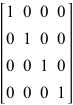
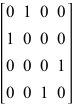
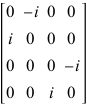
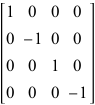 |  | ![[1 0 0 0; 0 1 0 0; 0 0 1 0; 0 0 0 1]](/images/equations/DiracMatrices/Inline30.svg) |
(4)
|
 |  | ![[0 1 0 0; 1 0 0 0; 0 0 0 1; 0 0 1 0]](/images/equations/DiracMatrices/Inline33.svg) |
(5)
|
 |  | ![[0 -i 0 0; i 0 0 0; 0 0 0 -i; 0 0 i 0]](/images/equations/DiracMatrices/Inline36.svg) |
(6)
|
 |  | ![[1 0 0 0; 0 -1 0 0; 0 0 1 0; 0 0 0 -1]](/images/equations/DiracMatrices/Inline39.svg) |
(7)
|
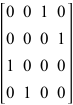
 |  | ![[0 0 1 0; 0 0 0 1; 1 0 0 0; 0 1 0 0]](/images/equations/DiracMatrices/Inline42.svg) |
(8)
|
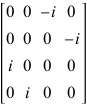
 |  | ![[0 0 -i 0; 0 0 0 -i; i 0 0 0; 0 i 0 0]](/images/equations/DiracMatrices/Inline45.svg) |
(9)
|
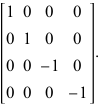
 |  | ![[1 0 0 0; 0 1 0 0; 0 0 -1 0; 0 0 0 -1].](/images/equations/DiracMatrices/Inline48.svg) |
(10)
|
The auxiliary matrices satisfy the anticommutator identities
 |
(11)
|
 |
(12)
|
where  is the Kronecker delta, and the commutator
identity
is the Kronecker delta, and the commutator
identity
![[sigma_i,rho_j]=sigma_irho_j-rho_jsigma_i=0,](/images/equations/DiracMatrices/NumberedEquation4.svg) |
(13)
|
as well as
 |
(14)
|
 |
(15)
|
when  is a cyclic permutation of
  . The factor
  on the right is the imaginary
unit.
on the right is the imaginary
unit.
The 16 matrices
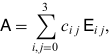 |
(16)
|
for  ,
1, 2, 3 form the Dirac matrix basis (Arfken 1985, p. 212). Here
,
1, 2, 3 form the Dirac matrix basis (Arfken 1985, p. 212). Here  and
and  . This vector basis
contains the six auxiliary matrices, the identity
matrix, and nine products
. This vector basis
contains the six auxiliary matrices, the identity
matrix, and nine products  with
with  , 2, 3. Its elements satisfy
1.  ,
where
,
where  is the determinant,
2.  ,
,
3.  ,
where
,
where  denotes the conjugate transpose, making them
Hermitian. Together with
denotes the conjugate transpose, making them
Hermitian. Together with  , this also makes them unitary,
4.  ,
except
,
except 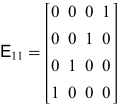 ,
where
,
where  is the matrix trace,
5. Any product of two basis elements is another basis element multiplied by one of  ,
,  ,
,  , or
, or  ,
,
6. The 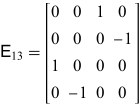 are linearly independent,
7. The  form a vector basis, so any
  complex matrix may
be written as
complex matrix may
be written as
 |
(17)
|
where the complex coefficients are given by
 |
(18)
|
The coefficients are real when 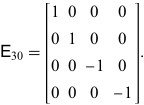 is Hermitian (Arfken 1985). The coefficient
formula follows from
is Hermitian (Arfken 1985). The coefficient
formula follows from
 |
(19)
|
The four Hermitian matrices in the Hamiltonian form of the Dirac equation can be chosen as
 |  |  |
(20)
|
 |  |  |
(21)
|
for  ,
2, 3, giving
,
2, 3, giving
 |  | ![E_(11)=[0 0 0 1; 0 0 1 0; 0 1 0 0; 1 0 0 0]](/images/equations/DiracMatrices/Inline84.svg) |
(22)
|
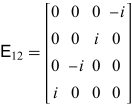
 |  | ![E_(12)=[0 0 0 -i; 0 0 i 0; 0 -i 0 0; i 0 0 0]](/images/equations/DiracMatrices/Inline87.svg) |
(23)
|
 |  | ![E_(13)=[0 0 1 0; 0 0 0 -1; 1 0 0 0; 0 -1 0 0]](/images/equations/DiracMatrices/Inline90.svg) |
(24)
|
 |  | ![E_(30)=[1 0 0 0; 0 1 0 0; 0 0 -1 0; 0 0 0 -1].](/images/equations/DiracMatrices/Inline93.svg) |
(25)
|
The notation  is sometimes also used (Bjorken and Drell 1964, p. 8; Berestetskii et al.
1982, p. 78). The additional matrix
is sometimes also used (Bjorken and Drell 1964, p. 8; Berestetskii et al.
1982, p. 78). The additional matrix
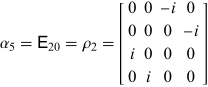
![alpha_5=E_(20)=rho_2=[0 0 -i 0; 0 0 0 -i; i 0 0 0; 0 i 0 0]](/images/equations/DiracMatrices/NumberedEquation11.svg) |
(26)
|
extends this set to five pairwise anticommuting matrices. With this convention,
 |
(27)
|
Thus the fifth matrix is derived from the first four.
The corresponding gamma matrices in the Dirac representation are
 |  | ![beta=rho_3=[I_2 0_2; 0_2 -I_2]](/images/equations/DiracMatrices/Inline97.svg) |
(28)
|
 |  | ![betaalpha_i=irho_2sigma_i=[0_2 sigma_i^((P)); -sigma_i^((P)) 0_2]](/images/equations/DiracMatrices/Inline100.svg) |
(29)
|
for  ,
2, 3, where
,
2, 3, where  is the
  zero matrix. In particular, every block is
  . Some conventions label the time matrix
by 4 rather than 0.
. Some conventions label the time matrix
by 4 rather than 0.
Another choice is the Weyl or chiral representation,
 |  | ![[0_2 I_2; I_2 0_2]](/images/equations/DiracMatrices/Inline107.svg) |
(30)
|
 |  | ![[0_2 sigma_i^((P)); -sigma_i^((P)) 0_2],](/images/equations/DiracMatrices/Inline110.svg) |
(31)
|
which satisfies the same anticommutator relations (Tong). Equivalent representations are related by a simultaneous similarity transformation of all four gamma matrices.
An additional gamma matrix is conventionally defined by
 |
(32)
|
The overall sign of this definition varies between references. With the sign chosen here,
 |  |  |
(33)
|
 |  |  |
(34)
|
It is a product of the four spacetime generators. In the Dirac representation  , whereas
  , so these two fifth matrices are distinct.
Other sets of Dirac matrices are sometimes defined as
 |  |  |
(35)
|
 |  |  |
(36)
|
 |  |  |
(37)
|
and
 |
(38)
|
for  ,
2, 3 (Arfken 1985).
,
2, 3 (Arfken 1985).
Each of the 15 nonidentity basis elements commutes with eight of the 16 basis elements, including itself and the identity matrix, and
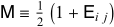
anticommutes with the other eight. The matrix  satisfies
 |
(39)
|
so it is a projection matrix (Arfken 1985, p. 216). In addition,
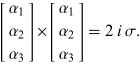
![[alpha_1; alpha_2; alpha_3]×[alpha_1; alpha_2; alpha_3]=2i[sigma_1; sigma_2; sigma_3],](/images/equations/DiracMatrices/NumberedEquation16.svg) |
(40)
|
where the cross product is evaluated using ordered matrix multiplication of the components.
The products of  and
and  satisfy
 |
(41)
|
 |
(42)
|
The 15 nonidentity basis elements contain exactly six pairwise anticommuting sets of five matrices each (Arfken 1985, p. 214),
1.  ,
,
 ,
,  ,
,  ,
,  ,
,
2.  ,
,
 ,
,  ,
,  ,
,  ,
,
3.  ,
,
 ,
,  ,
,  ,
,  ,
,
4.  ,
,
 ,
,  ,
,  ,
,  ,
,
5.  ,
,
 ,
,  ,
,  ,
,  ,
,
6.  ,
,
 ,
,  ,
,  ,
,  .
.
The basis elements  can be constructed in the Wolfram Language
as KroneckerProduct[PauliMatrix[i],
PauliMatrix[j]], where PauliMatrix[0]
is the
can be constructed in the Wolfram Language
as KroneckerProduct[PauliMatrix[i],
PauliMatrix[j]], where PauliMatrix[0]
is the  identity matrix and
  , 1, 2, 3. The Wolfram Function Repository also provides
ResourceFunction["DiracMatrix"][n] (Zeleny).
, 1, 2, 3. The Wolfram Function Repository also provides
ResourceFunction["DiracMatrix"][n] (Zeleny).
