


The Pauli matrices, also called the Pauli spin matrices, are complex matrices that arise in Pauli's treatment of spin in quantum mechanics. They are defined by
 |  | ![sigma_x=P_1=[ 0 1; 1 0]](/images/equations/PauliMatrices/Inline3.svg) |
(1)
|
 |  | ![sigma_y=P_2=[ 0 -i; i 0]](/images/equations/PauliMatrices/Inline6.svg) |
(2)
|
 |  | ![sigma_z=P_3=[ 1 0; 0 -1]](/images/equations/PauliMatrices/Inline9.svg) |
(3)
|
(Condon and Morse 1929, p. 213; Gasiorowicz 1974, p. 232; Goldstein 1980, p. 156; Liboff 1980, p. 453; Arfken 1985, p. 211; Griffiths 1987, p. 115; Landau and Lifschitz 1991, p. 204; Landau 1996, p. 224).
The Pauli matrices  are implemented in the Wolfram Language
as PauliMatrix[n],
where
are implemented in the Wolfram Language
as PauliMatrix[n],
where  ,
2, or 3.
,
2, or 3.
The Pauli spin matrices satisfy the identities
 |  |  |
(4)
|
 |  |  |
(5)
|
 |  | 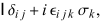 |
(6)
|
where  is the
  identity matrix,
  is the Kronecker delta,
 is the permutation
symbol, the leading
is the permutation
symbol, the leading  is the imaginary unit (not the index
  ), and Einstein
summation is used in (6) to sum over the index
), and Einstein
summation is used in (6) to sum over the index  (Arfken 1985, p. 211; Griffiths 1987, p. 139; Landau
and Lifschitz 1991, pp. 204-205).
(Arfken 1985, p. 211; Griffiths 1987, p. 139; Landau
and Lifschitz 1991, pp. 204-205).
The Pauli matrices plus the  identity matrix
  form a complete set, so any
  matrix
  can be expressed as
 |
(7)
|
The associated matrices
 |  | ![2[0 1; 0 0]](/images/equations/PauliMatrices/Inline34.svg) |
(8)
|
 |  | ![2[0 0; 1 0]](/images/equations/PauliMatrices/Inline37.svg) |
(9)
|
 |  | ![3[1 0; 0 1]](/images/equations/PauliMatrices/Inline40.svg) |
(10)
|
can also be defined.
