


A die (plural "dice") is a solid with markings on each of its faces. The faces are usually all the same shape, making Platonic solids and Archimedean duals the obvious choices. The die can be "rolled" by throwing it in the air and allowing it to come to rest on one of its faces. Dice are used in many games of chance as a way of picking random numbers on which to bet, and are used in board or role-playing games to determine the number of spaces to move, results of a conflict, etc. A coin can be viewed as a degenerate 2-sided case of a die.

Dice long predate the modern cube. Four elongated wooden dice from Shahr-e Sukhteh in Iran, dated to roughly 2500-2300 BC, are six-faced parallelepipeds numbered only on their four long faces. They were found with a board for the Game of Twenty Squares and are among the oldest known dice (Piperno and Salvatori 1983).

Greco-Roman Egypt also produced 20-sided dice shaped as icosahedra, including examples labeled with Greek numerals and one first-century example whose faces name 20 Egyptian divinities (Minas-Nerpel 2007, Horster 2017).
In 1787, Mozart wrote the measures and instructions for a musical composition dice game. The idea is to cut and paste pre-written measures of music together to create a Minuet (Chuang).

The most common type of die is a six-sided cube with the numbers 1-6 placed on the faces. The value of the roll is indicated by the number of "spots" showing on the top. For the six-sided die, opposite faces are arranged to always sum to seven. This gives two possible mirror image arrangements in which the numbers 1, 2, and 3 may be arranged in a clockwise or counterclockwise order about a corner. Commercial dice may, in fact, have either orientation. The illustrations above show 6-sided dice with counterclockwise and clockwise arrangements, respectively, when viewed from along the three-fold rotation axis towards the center of the die.
The cube has the nice property that there is an upward-pointing face opposite the bottom face from which the value of the "roll" can easily
be read. This would not be true, for instance, for a tetrahedral
die, which would have to be picked up and turned over to reveal the number underneath
(although it could be determined by noting which number 1-4 was not visible
on one of the upper three faces). The arrangement of five spots  corresponding to a roll of 5 on a six-sided die is called the quincunx.
There are also special names for certain rolls of two six-sided dice: two 1s are
called snake eyes and two 6s are called Boxcars.
corresponding to a roll of 5 on a six-sided die is called the quincunx.
There are also special names for certain rolls of two six-sided dice: two 1s are
called snake eyes and two 6s are called Boxcars.
Shapes of dice other than the usual 6-sided cube are commercially available from companies such as Dice & Games, Ltd.® Diaconis and Keller (1989) show that there exist "fair" dice other than the usual Platonic solids and duals of the Archimedean solids, where a fair die is one for which its symmetry group acts transitively on its faces (i.e., isohedra). There are 30 isohedra.
The probability of obtaining  points (a roll of
  )
on
)
on 
 -sided dice can be computed as follows. The number of ways
in which
-sided dice can be computed as follows. The number of ways
in which  can be obtained is the coefficient
of
can be obtained is the coefficient
of  in
in
 |
(1)
|
since each possible arrangement contributes one term.  can be written as a multinomial
series
can be written as a multinomial
series
 |  |  |
(2)
|
 |  |  |
(3)
|
so the desired number  is the coefficient of
  in
in
 |
(4)
|
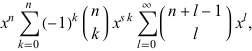
Expanding,
 |
(5)
|
so in order to get the coefficient of  , include all terms with
 |
(6)
|
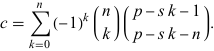
 is therefore
 |
(7)
|
But  only when
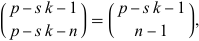
  , so the other terms do not contribute. Furthermore,
 |
(8)
|
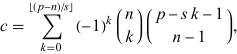
so
 |
(9)
|
where  is the floor
function, and
is the floor
function, and
 |
(10)
|
(Uspensky 1937, pp. 23-24).
Consider now  .
For
.
For  six-sided dice,
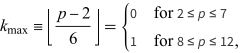 |
(11)
|
and
 |  | 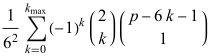 |
(12)
|
 |  | 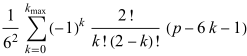 |
(13)
|
 |  | 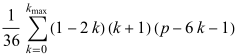 |
(14)
|
 |  |  |
(15)
|
 |  |  |
(16)
|
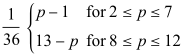
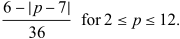
The most common roll is therefore seen to be a 7, with probability  , and the least common rolls are 2 and 12, both with
probability 1/36.
, and the least common rolls are 2 and 12, both with
probability 1/36.
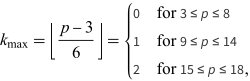
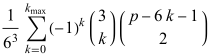
For  six-sided dice,
 |
(17)
|
and
 |  |  |
(18)
|
 |  |  |
(19)
|
 |  |  |
(20)
|
 |  |  |
(21)
|
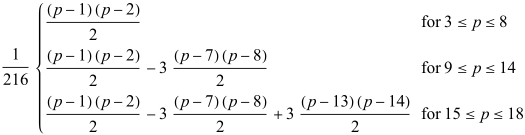
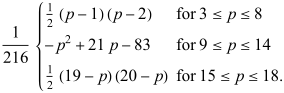
For three six-sided dice, the most common rolls are 10 and 11, both with probability 1/8; and the least common rolls are 3 and 18, both with probability 1/216.
For four six-sided dice, the most common roll is 14, with probability 73/648; and the least common rolls are 4 and 24, both with probability 1/1296.
In general, the likeliest roll  for
for 
 -sided dice is given by
 |
(22)
|
which can be written explicitly as
![p_L(n,s)={1/2n(s+1) for n even; 1/2[n(s+1)-1] for n odd, s even; 1/2n(s+1) for n odd, s odd.](/images/equations/Dice/NumberedEquation12.svg) |
(23)
|
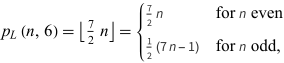
For 6-sided dice, the likeliest rolls are given by
 |
(24)
|
or 7, 10, 14, 17, 21, 24, 28, 31, 35, ... for  , 3, ... (OEIS A030123)
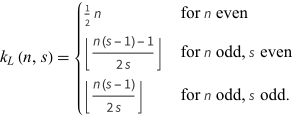
dice. The probabilities corresponding to the most likely rolls can be computed by
plugging
, 3, ... (OEIS A030123)
dice. The probabilities corresponding to the most likely rolls can be computed by
plugging  into the general formula together
with
into the general formula together
with
 |
(25)
|
Unfortunately,  does not have a simple closed-form expression in terms of
  and
and  .
However, the probabilities of obtaining the likeliest roll totals can be found explicitly
for a particular
.
However, the probabilities of obtaining the likeliest roll totals can be found explicitly
for a particular  .
For
.
For  6-sided dice, the probabilities are 1/6,
1/8, 73/648, 65/648, 361/3888, 24017/279936, 7553/93312, ... for
6-sided dice, the probabilities are 1/6,
1/8, 73/648, 65/648, 361/3888, 24017/279936, 7553/93312, ... for  , 3, ....

The probabilities for obtaining a given total using  6-sided dice are shown above for
  , 2, 3, and 4 dice. They can be seen to approach a normal
distribution as the number of dice is increased.
, 2, 3, and 4 dice. They can be seen to approach a normal
distribution as the number of dice is increased.
