


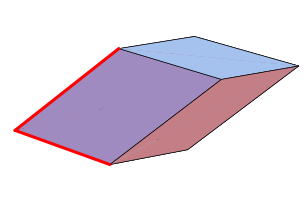
In three dimensions, a parallelepiped is a prism whose faces are all parallelograms. Let  ,
,  ,
and
,
and  be the basis vectors defining a three-dimensional parallelepiped. Then the parallelepiped
has volume given by the scalar
triple product
be the basis vectors defining a three-dimensional parallelepiped. Then the parallelepiped
has volume given by the scalar
triple product
 |  |  |
(1)
|
 |  |  |
(2)
|
 |  |  |
(3)
|
In  dimensions, a parallelepiped is the polytope spanned
by
dimensions, a parallelepiped is the polytope spanned
by  vectors
  , ...,
  in a vector space over the
reals,
in a vector space over the
reals,
 |
(4)
|
where ![t_i in [0,1]](/images/equations/Parallelepiped/Inline17.svg) for
for  ,
...,
,
...,  .
In the usual interpretation, the vector space is
taken as Euclidean space, and the content
of this parallelepiped is given by
.
In the usual interpretation, the vector space is
taken as Euclidean space, and the content
of this parallelepiped is given by
 |
(5)
|
where the sign of the determinant is taken to be the "orientation" of the "oriented volume" of the parallelepiped.
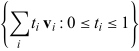
Given  vectors
  ,
...,
,
...,  in
in  -dimensional
space, their convex hull (along with the zero
vector)
-dimensional
space, their convex hull (along with the zero
vector)
 |
(6)
|
is called a parallelepiped, generalizing the notion of a parallelogram, or rather its interior, in the plane. If the number of vectors is equal to the dimension, then
 |
(7)
|
is a square matrix, and the volume of the parallelepiped is given by  ,
where the columns of
,
where the columns of  are given by the vectors
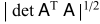
  . More generally, a parallelepiped has
  dimensional volume given by
  .
.
When the vectors are tangent vectors, then the parallelepiped represents an infinitesimal  -dimensional volume element.
Integrating this volume can give formulas for the volumes of
-dimensional volume element.
Integrating this volume can give formulas for the volumes of  -dimensional objects in
  -dimensional space. More intrinsically, the parallelepiped
corresponds to a decomposable element of the exterior algebra
-dimensional space. More intrinsically, the parallelepiped
corresponds to a decomposable element of the exterior algebra  .
.
