A cyclic number is an -digit integer that, when multiplied
by 1, 2, 3, ..., ,
produces the same digits in a different order. Cyclic numbers are generated by the
full reptend primes, i.e., 7, 17, 19, 23, 29,
47, 59, 61, 97, ... (OEIS A001913).
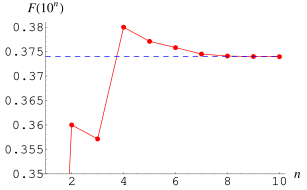
The numbers of cyclic numbers for , 1, 2, ... are 0, 1, 9, 60, 467, 3617, 25883, 248881, 2165288,
19016617, 170169241, ... (OEIS A086018). It
has been conjectured, but not yet proven, that an infinite
number of cyclic numbers exist. In fact, the fraction
of cyclic numbers out of all primes has been conjectured
to be Artin's constant. The fraction of cyclic numbers among primes
is 0.3739551.
When a cyclic number is multiplied by its generator, the result is a string of 9s.
This is a special case of Midy's theorem.
See Yates (1973) for a table of prime period lengths for primes.


 -digit integer that, when multiplied
by 1, 2, 3, ...,
-digit integer that, when multiplied
by 1, 2, 3, ...,  ,
produces the same digits in a different order. Cyclic numbers are generated by the
full reptend primes, i.e., 7, 17, 19, 23, 29,
47, 59, 61, 97, ... (OEIS A001913).
,
produces the same digits in a different order. Cyclic numbers are generated by the
full reptend primes, i.e., 7, 17, 19, 23, 29,
47, 59, 61, 97, ... (OEIS A001913).









 for
for  , 1, 2, ... are 0, 1, 9, 60, 467, 3617, 25883, 248881, 2165288,
19016617, 170169241, ... (OEIS A086018). It
has been conjectured, but not yet proven, that an infinite
number of cyclic numbers exist. In fact, the fraction
of cyclic numbers out of all primes has been conjectured
to be Artin's constant
, 1, 2, ... are 0, 1, 9, 60, 467, 3617, 25883, 248881, 2165288,
19016617, 170169241, ... (OEIS A086018). It
has been conjectured, but not yet proven, that an infinite
number of cyclic numbers exist. In fact, the fraction
of cyclic numbers out of all primes has been conjectured
to be Artin's constant  . The fraction of cyclic numbers among primes
 is 0.3739551.
 .
.

 ."
."