


In plane geometry, a chord is the line segment joining two points on a curve. The term is often used to describe a line segment whose ends lie on a circle.
The term is also used in graph theory, where a cycle chord of a graph cycle  is an edge not in
  whose endpoints lie in
  .
.
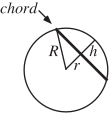
In the above figure,  is the radius of the circle,
 is the chord length,
  is called the apothem, and
  the sagitta.
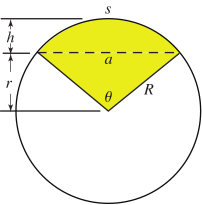
|
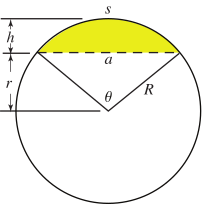
|
The shaded region in the left figure is called a circular sector, and the shaded region in the right figure is called a circular segment.
There are a number of interesting theorems about chords of circles. All angles inscribed in a circle and subtended by the same chord are equal. The converse is also true: The locus of all points from which a given segment subtends equal angles is a circle.
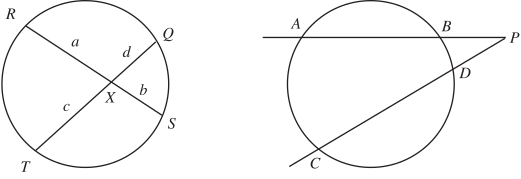
In the left figure above,
 |
(1)
|
(Jurgensen 1963, p. 345). In the right figure above,
 |
(2)
|
which is a statement of the fact that the circle power is independent of the choice of the line  (Coxeter 1969, p. 81; Jurgensen 1963, p. 346).
Given any closed convex curve, it is possible to find a point  through which three chords, inclined to one another at angles
of
through which three chords, inclined to one another at angles
of  , pass such that
  is the midpoint of all three
(Wells 1991).
is the midpoint of all three
(Wells 1991).
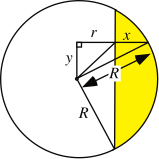
Let a circle of radius  have a chord at distance
  . The area enclosed by the chord,
shown as the shaded region in the above figure, is then
. The area enclosed by the chord,
shown as the shaded region in the above figure, is then
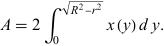 |
(3)
|
But
 |
(4)
|
so
 |
(5)
|
and
 |  | 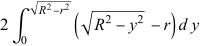 |
(6)
|
 |  |  |
(7)
|
Checking the limits, when  ,
,
 and when
  ,
,
 |
(8)
|
the expected area of the semicircle.
