Conditional Probability

EXPLORE THIS TOPIC IN the MathWorld Classroom

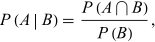
The conditional probability of an event A assuming that B has occurred, denoted P(A|B), equals

 P(A|B)=(P(A intersection B))/(P(B)),
(1)

which can be proven directly using a Venn diagram. Multiplying through, this becomes

 P(A|B)P(B)=P(A intersection B),
(2)

which can be generalized to

 P(A intersection B intersection C)=P(A)P(B|A)P(C|A intersection B).
(3)

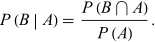
Rearranging (1) gives

 P(B|A)=(P(B intersection A))/(P(A)).
(4)

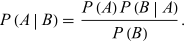
Solving (4) for P(B intersection A)=P(A intersection B) and plugging in to (1) gives

 P(A|B)=(P(A)P(B|A))/(P(B)).
(5)

Wolfram Web Resources

Mathematica »

The #1 tool for creating Demonstrations and anything technical.

Wolfram|Alpha »

Explore anything with the first computational knowledge engine.

Wolfram Demonstrations Project »

Explore thousands of free applications across science, mathematics, engineering, technology, business, art, finance, social sciences, and more.

Computerbasedmath.org »

Join the initiative for modernizing math education.

Online Integral Calculator »

Solve integrals with Wolfram|Alpha.

Step-by-step Solutions »

Walk through homework problems step-by-step from beginning to end. Hints help you try the next step on your own.

Wolfram Problem Generator »

Unlimited random practice problems and answers with built-in Step-by-step solutions. Practice online or make a printable study sheet.

Wolfram Education Portal »

Collection of teaching and learning tools built by Wolfram education experts: dynamic textbook, lesson plans, widgets, interactive Demonstrations, and more.

Wolfram Language »

Knowledge-based programming for everyone.