


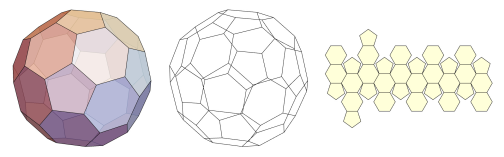

The truncated icosahedron is the 32-faced Archimedean solid with 60 vertices corresponding to the facial arrangement 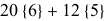 . It is also the uniform
polyhedron with Maeder index 25 (Maeder 1997), Wenninger index 9 (Wenninger 1989),
Coxeter index 27 (Coxeter et al. 1954), and Har'El index 30 (Har'El 1993).
It has Schläfli symbol t
. It is also the uniform
polyhedron with Maeder index 25 (Maeder 1997), Wenninger index 9 (Wenninger 1989),
Coxeter index 27 (Coxeter et al. 1954), and Har'El index 30 (Har'El 1993).
It has Schläfli symbol t and Wythoff symbol
  . It is illustrated above together
with a wireframe version and a net that can be used for its
construction.
. It is illustrated above together
with a wireframe version and a net that can be used for its
construction.
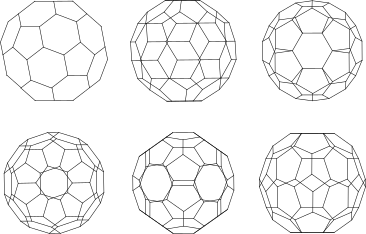
Several symmetrical projections of the truncated icosahedron are illustrated above.
It is implemented in the Wolfram Language as PolyhedronData["TruncatedIcosahedron"].
The lenses used for focusing the explosive shock waves of the detonators in the Fat Man atomic bomb were constructed in the configuration of a truncated icosahedron
(Rhodes 1996, p. 195). It did not however became a familiar household shape
until the 1970 introduction of the Adidas Telstar soccer
ball, whose white hexagons surrounding black pentagons forming a truncated icosahedron
are now iconically associated with the sport of soccer. The truncated icosahedron
is also known to chemists as the  structure of pure carbon known as a buckyball (a.k.a.
fullerenes).
structure of pure carbon known as a buckyball (a.k.a.
fullerenes).
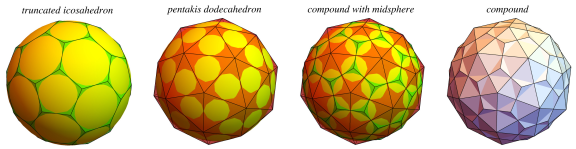
The dual polyhedron of the truncated icosahedron is the pentakis dodecahedron, both of which
are illustrated above together with their common midsphere.
The inradius  of the dual, midradius
  of the solid and dual, and circumradius
  of the solid for
  are
are
 |  |  |
(1)
|
 |  |  |
(2)
|
 |  |  |
(3)
|
The distances from the center of the solid to the centroids of the pentagonal and hexagonal faces are given by
 |  | 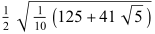 |
(4)
|
 |  | 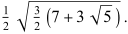 |
(5)
|
The surface area and volume are
 |  |  |
(6)
|
 |  | 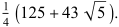 |
(7)
|
The unit truncated icosahedron has Dehn invariant
 |  |  |
(8)
|
 |  |  |
(9)
|
 |  |  |
(10)
|
(OEIS A377787), where the first expression uses the basis of Conway et al. (1999).
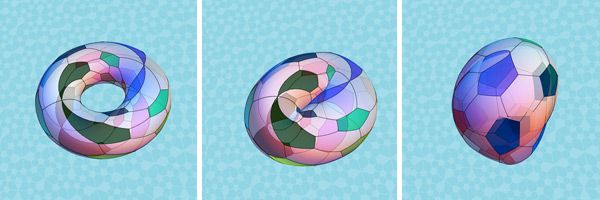
M. Trott illustrates how a torus can be continuously deformed into two concentric soccer balls of identical size and orientation with
no tearing of the surface in this transition. In particular, the animation
(a few frames of which are illustrated above) shows a smooth homotopy
between the identity map and a particular map involving
the Weierstrass elliptic function  , which is a doubly-periodic
function whose natural domain is a periodic parallelogram
in the complex
, which is a doubly-periodic
function whose natural domain is a periodic parallelogram
in the complex  -plane.

 ." §3.7.10 in
  Trott, M. "Constructing
a Buckyball with Mathematica: A Combination of Geometry and Algebra from Classical
and Modern Mathematics."
Trott, M. "Constructing
a Buckyball with Mathematica: A Combination of Geometry and Algebra from Classical
and Modern Mathematics."