


Angle addition formulas express trigonometric functions of sums of angles  in terms of functions of
  and
and  . The fundamental formulas of angle addition in trigonometry
are given by
. The fundamental formulas of angle addition in trigonometry
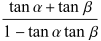
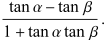
are given by
 |  |  |
(1)
|
 |  |  |
(2)
|
 |  |  |
(3)
|
 |  |  |
(4)
|
 |  |  |
(5)
|
 |  |  |
(6)
|
The first four of these are known as the prosthaphaeresis formulas, or sometimes as Simpson's formulas.
The sine and cosine angle addition identities can be compactly summarized by the matrix equation
![[cosalpha sinalpha; -sinalpha cosalpha][cosbeta sinbeta; -sinbeta cosbeta]=[cos(alpha+beta) sin(alpha+beta); -sin(alpha+beta) cos(alpha+beta)].](/images/equations/TrigonometricAdditionFormulas/NumberedEquation1.svg) |
(7)
|
These formulas can be simply derived using complex exponentials and the Euler formula as follows.
 |  |  |
(8)
|
 |  |  |
(9)
|
 |  |  |
(10)
|
 |  |  |
(11)
|
Equating real and imaginary parts then gives (1) and (3), and (2) and (4) follow immediately by substituting
 for
for  .
.
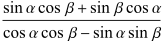
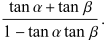
Taking the ratio of (1) and (3) gives the tangent angle addition formula
 |  |  |
(12)
|
 |  |  |
(13)
|
 |  |  |
(14)
|
 |  |  |
(15)
|
The double-angle formulas are
 |  |  |
(16)
|
 |  |  |
(17)
|
 |  |  |
(18)
|
 |  |  |
(19)
|
 |  |  |
(20)
|
Multiple-angle formulas are given by
 |  | ![sum_(k=0)^(n)(n; k)cos^kxsin^(n-k)xsin[1/2(n-k)pi]](/images/equations/TrigonometricAdditionFormulas/Inline65.svg) |
(21)
|
 |  | ![sum_(k=0)^(n)(n; k)cos^kxsin^(n-k)xcos[1/2(n-k)pi],](/images/equations/TrigonometricAdditionFormulas/Inline68.svg) |
(22)
|
and can also be written using the recurrence relations
 |  | ![2sin[(n-1)x]cosx-sin[(n-2)x]](/images/equations/TrigonometricAdditionFormulas/Inline71.svg) |
(23)
|
 |  | ![2cos[(n-1)x]cosx-cos[(n-2)x]](/images/equations/TrigonometricAdditionFormulas/Inline74.svg) |
(24)
|
 |  | ![(tan[(n-1)x]+tanx)/(1-tan[(n-1)x]tanx).](/images/equations/TrigonometricAdditionFormulas/Inline77.svg) |
(25)
|

The angle addition formulas can also be derived purely algebraically without the use of complex numbers. Consider the small right triangle in the figure above, which gives
 |  |  |
(26)
|
 |  |  |
(27)
|
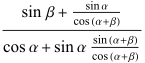
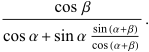
Now, the usual trigonometric definitions applied to the large right triangle give
 |  |  |
(28)
|
 |  |  |
(29)
|
 |  |  |
(30)
|
 |  |  |
(31)
|
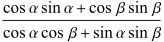
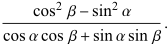
Solving these two equations simultaneously for the variables  and
and  then immediately gives
 |  |  |
(32)
|
 |  |  |
(33)
|
These can be put into the familiar forms with the aid of the trigonometric identities
 |
(34)
|
and
 |  |  |
(35)
|
 |  |  |
(36)
|
 |  |  |
(37)
|
 |  |  |
(38)
|
which can be verified by direct multiplication. Plugging (34) into (32) and (38) into (33) then gives
 |  |  |
(39)
|
 |  |  |
(40)
|
as before.

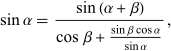
A similar proof due to Smiley and Smiley uses the left figure above to obtain
 |
(41)
|
from which it follows that
 |
(42)
|
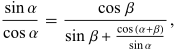
Similarly, from the right figure,
 |
(43)
|
so
 |
(44)
|

Similar diagrams can be used to prove the angle subtraction formulas (Smiley 1999, Smiley and Smiley). In the figure at left,
 |  |  |
(45)
|
 |  |  |
(46)
|
 |  |  |
(47)
|
giving
 |
(48)
|
Similarly, in the figure at right,
 |  |  |
(49)
|
 |  |  |
(50)
|
 |  |  |
(51)
|
giving
 |
(52)
|

A more complex diagram can be used to obtain a proof from the  identity (Ren 1999). In the above figure, let
 .
Then
.
Then
 |
(53)
|
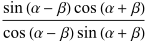
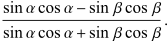
An interesting identity relating the sum and difference tangent formulas is given by
 |  |  |
(54)
|
 |  |  |
(55)
|
 |  |  |
(56)
|

 ." College Math. J. 30, 212,
1999.Smiley, L. M. "Proof without Words: Geometry of Subtraction
Formulas." Math. Mag. 72, 366, 1999.Smiley, L. and
Smiley, D. "Geometry of Addition and Subtraction Formulas."
." College Math. J. 30, 212,
1999.Smiley, L. M. "Proof without Words: Geometry of Subtraction
Formulas." Math. Mag. 72, 366, 1999.Smiley, L. and
Smiley, D. "Geometry of Addition and Subtraction Formulas."