

The special unitary group  is the subgroup of the unitary group
  consisting of
  unitary matrices
with determinant 1,
unitary matrices
with determinant 1,
 |
(1)
|
It is a connected compact Lie group of real dimension  and is also called the unitary unimodular group. The determinant gives the exact
sequence
and is also called the unitary unimodular group. The determinant gives the exact
sequence
 |
(2)
|
Its Lie algebra consists of the antihermitian matrices having matrix trace zero,
 |
(3)
|
where  denotes the set of all
  complex matrices.
The group center consists of the scalar
matrices
complex matrices.
The group center consists of the scalar
matrices  ,
where
,
where  is an
is an  th
root of unity and
th
root of unity and  is the
  identity matrix.
Factoring by the group center gives the projective
special unitary group
identity matrix.
Factoring by the group center gives the projective
special unitary group  . The group
  is simply connected.
The notation 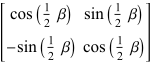 instead denotes a finite special unitary group. Its elements are matrices
over the finite field
instead denotes a finite special unitary group. Its elements are matrices
over the finite field  that preserve a nondegenerate Hermitian
form and have determinant 1. For a finite group
that preserve a nondegenerate Hermitian
form and have determinant 1. For a finite group  ,
,  denotes its group order.
In particular,
denotes its group order.
In particular,
 |
(4)
|
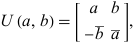
The group  can be represented by matrices
![U(a,b)=[a b; -b^_ a^_],](/images/equations/SpecialUnitaryGroup/NumberedEquation5.svg) |
(5)
|
where  and
and  are the Cayley-Klein parameters. The group
  may also be represented by matrices
![U(xi,eta,zeta)=[e^(ixi)coseta e^(izeta)sineta; -e^(-izeta)sineta e^(-ixi)coseta],](/images/equations/SpecialUnitaryGroup/NumberedEquation6.svg) |
(6)
|
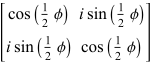
or the matrices
 |  | ![[cos(1/2phi) isin(1/2phi); isin(1/2phi) cos(1/2phi)]](/images/equations/SpecialUnitaryGroup/Inline24.svg) |
(7)
|
 |  | ![[cos(1/2beta) sin(1/2beta); -sin(1/2beta) cos(1/2beta)]](/images/equations/SpecialUnitaryGroup/Inline27.svg) |
(8)
|
 |  | ![[e^(ixi) 0; 0 e^(-ixi)].](/images/equations/SpecialUnitaryGroup/Inline30.svg) |
(9)
|
The first parameterization identifies  with the group of unit quaternions,
and hence with the 3-sphere
with the group of unit quaternions,
and hence with the 3-sphere  . Conjugation of pure imaginary
quaternions gives a surjective group homomorphism from
. Conjugation of pure imaginary
quaternions gives a surjective group homomorphism from  onto the rotation group
  with kernel
  , so
, so
 |
(10)
|
Thus  is simply connected and is the universal
cover and double cover of
is simply connected and is the universal
cover and double cover of  .
.
The group representation of dimension  , whose entries are Wigner
D-functions, is
, whose entries are Wigner
D-functions, is
 |
(11)
|
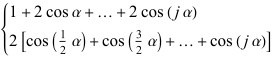
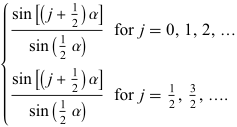
The sum is terminated by putting  . The group character
is given by
. The group character
is given by
 |  | ![{1+2cosalpha+...+2cos(jalpha) ; 2[cos(1/2alpha)+cos(3/2alpha)+...+cos(jalpha)]](/images/equations/SpecialUnitaryGroup/Inline42.svg) |
(12)
|
 |  | ![{(sin[(j+1/2)alpha])/(sin(1/2alpha)) for j=0,1,2,...; (sin[(j+1/2)alpha])/(sin(1/2alpha)) for j=1/2,3/2,....](/images/equations/SpecialUnitaryGroup/Inline45.svg) |
(13)
|

 and
and  -
- Homomorphism."
  ,
,  ,
,  , and
, and  ." §2.2 in