


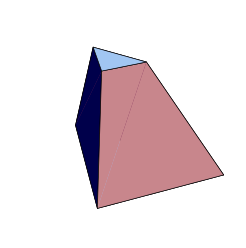
|
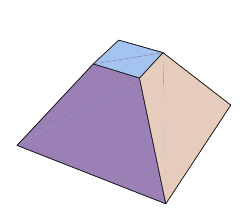
|
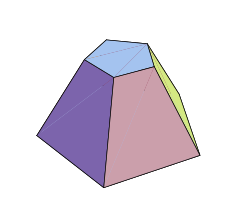
|
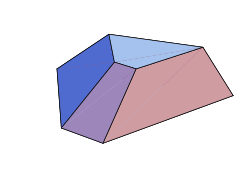
|
A pyramidal frustum is a frustum made by chopping the top off a pyramid. It is a special case of a prismatoid.
For a right pyramidal frustum, let  be the slant height,
  the height,
  the bottom base perimeter,
 the top base perimeter,
 the bottom area,
and
the bottom area,
and  the top area. Then the surface
area (of the sides) and volume of a pyramidal frustum
are given by
the top area. Then the surface
area (of the sides) and volume of a pyramidal frustum
are given by
 |  |  |
(1)
|
 |  |  |
(2)
|
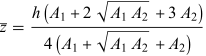
The geometric centroid of a right pyramidal frustum occurs at a height
 |
(3)
|
above the bottom base (Harris and Stocker 1998).
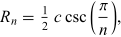
The bases of a right  -gonal
frustum are regular polygons of side lengths
-gonal
frustum are regular polygons of side lengths  and
and  with circumradii
 |
(4)
|
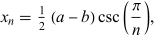
where  is the side length, so the diagonal connecting corresponding vertices on top and
bottom has length
is the side length, so the diagonal connecting corresponding vertices on top and
bottom has length
 |
(5)
|
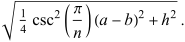
and the edge length is
 |  |  |
(6)
|
 |  |  |
(7)
|
The triangular ( )
and square (
)
and square ( )
right pyramidal frustums therefore have side surface areas
)
right pyramidal frustums therefore have side surface areas
 |  |  |
(8)
|
 |  |  |
(9)
|
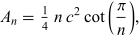
The area of a regular  -gon is
 |
(10)
|
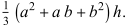
so the volumes of these frustums are
 |  |  |
(11)
|
 |  |  |
(12)
|
