


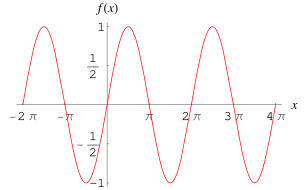
A function  is said to be periodic (or, when emphasizing the presence
of a single period instead of multiple periods, singly
periodic) with period
is said to be periodic (or, when emphasizing the presence
of a single period instead of multiple periods, singly
periodic) with period  if
if
 |
for  ,
2, .... For example, the sine function
,
2, .... For example, the sine function  , illustrated above, is periodic with least
period (often simply called "the" period)
, illustrated above, is periodic with least
period (often simply called "the" period)
 (as well as with period
  ,
,  ,
,  , etc.).
The constant function  is periodic with any period
  for all nonzero real
numbers
for all nonzero real
numbers  ,
so there is no concept analogous to the least period
for constant functions. The following table summarizes the names given to periodic
functions based on the number of independent periods they possess.
,
so there is no concept analogous to the least period
for constant functions. The following table summarizes the names given to periodic
functions based on the number of independent periods they possess.
| number of periods | name |
| 1 | singly periodic function |
| 2 | doubly periodic function |
| 3 | triply periodic function |
