


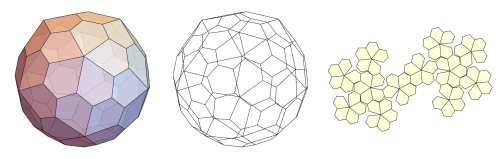

The pentagonal hexecontahedron is the 60-faced dual polyhedron of the snub dodecahedron (Holden 1971, p. 55). It is illustrated above together with a wireframe version and a net that can be used for its construction.
It is Wenninger dual  .
.
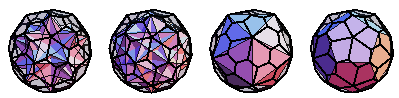
A tetrahedron 10-compound, cube 5-compound, icosahedron, and dodecahedron can be inscribed in the vertices of the pentagonal hexecontahedron (E. Weisstein, Dec. 25-27, 2009).
Its irregular pentagonal faces have vertex angles of
 |  | ![cos^(-1)[(64x^6-128x^5+64x^4+24x^3-24x^2+1)_1]](/images/equations/PentagonalHexecontahedron/Inline4.svg) |
(1)
|
 |  |  |
(2)
|
(four times) and
 |  | ![cos^(-1)[(64x^6-384x^5+384x^4+888x^3+168x^2-128x-31)_4]](/images/equations/PentagonalHexecontahedron/Inline10.svg) |
(3)
|
 |  |  |
(4)
|
(once), where  is a polynomial root.
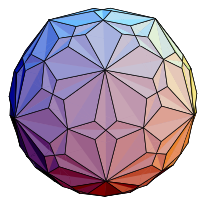
Because it is the dual of the chiral snub dodecahedron, the pentagonal hexecontahedron also comes in two enantiomorphous forms, known as laevo (left) and dextro (right). An attractive dual of the two enantiomers superposed on one another is illustrated above.
Starting with a snub dodecahedron with unit edge lengths, the edges lengths of the pentagonal hexecontahedron are given by the roots of
 |
(5)
|
 |
(6)
|
which have approximate values 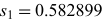 and
and  .
.
The surface area and volume are both given by the roots of 12th-order polynomial with large coefficients. They have approximate values  and
and  .
.
