


A partial derivative is a derivative of a function of several variables with respect to one variable, holding the others fixed.
 |
(1)
|
The above partial derivative is sometimes denoted  for brevity.
Repeated partial derivatives are denoted by subscripts recording the order of differentiation from left to right. The operators in Leibniz notation act from right to left (Lebl 2026, p. 60), so
 |  |  |
(2)
|
 |  |  |
(3)
|
 |  |  |
(4)
|
Such partial derivatives involving more than one variable are called mixed partial derivatives.
For a twice continuously differentiable function  in a neighborhood of
 ,
 |
(5)
|
More generally, if all partial derivatives of order at most  are continuous, their
order can be interchanged. For
 this gives
 |
(6)
|
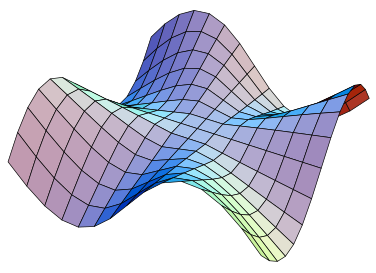
If the continuity requirement for mixed partials is dropped, it is possible to construct functions for which mixed partials are not equal. An example is the function
 |
(7)
|
which has  and
 (Wagon 1991, Trott 2006). This function is depicted
above and by Fischer (1986).
Abramowitz and Stegun (1972) give finite difference versions for partial derivatives.
A differential equation expressing one or more quantities in terms of partial derivatives is called a partial differential equation. Partial differential equations are extremely important in physics and engineering, and are in general difficult to solve.
