made with Mathematica technology MathWorld

Octahedron
DOWNLOAD Mathematica Notebook EXPLORE THIS TOPIC IN the MathWorld Classroom
OctahedraAll

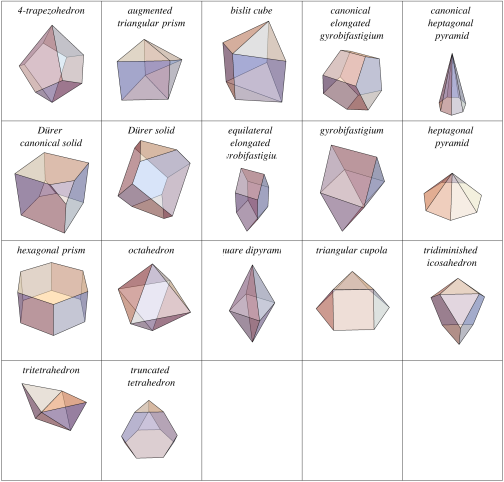
An octahedron is a polyhedron having eight faces. Examples include the augmented triangular prism (Johnson solid J_(49)), boat, gyrobifastigium (Johnson solid J_(26)), heptagonal pyramid, hexagonal prism, (regular) octahedron, square dipyramid, triangular cupola (Johnson solid J_3), tridiminished icosahedron (Johnson solid J_(63)), and truncated tetrahedron.

There are 257 convex octahedra, corresponding to the duals of the octahedral graphs. The convex octahedra consisting of regular polygonal faces of equal edge lengths are summarized in the following table. They all have V-E=6, as required by the polyhedral formula.

polyhedrondegree sequenceVE
truncated tetrahedron3, 3, 3, 3, 3, 3, 3, 3, 3, 3, 3, 31218
heptagonal pyramid3, 3, 3, 3, 3, 3, 3, 7814
triangular cupola3, 3, 3, 3, 3, 3, 4, 4, 4915
tridiminished icosahedron3, 3, 3, 3, 3, 3, 4, 4, 4915
gyrobifastigium3, 3, 3, 3, 4, 4, 4, 4814
augmented triangular prism3, 3, 4, 4, 4, 4, 4713
octahedron4, 4, 4, 4, 4, 4612
OctahedronNet

polyhdron net The regular octahedron is the Platonic solid P_4 with six polyhedron vertices, 12 polyhedron edges, and eight equivalent equilateral triangular faces, denoted 8{3}. It is also uniform polyhedron U_5 and Wenninger model W_2. It is given by the Schläfli symbol {3,4} and Wythoff symbol 4|23. The octahedron of unit side length is the antiprism of n=3 sides with height h=sqrt(6)/3. The octahedron is also a square dipyramid with equal edge lengths.

OctahedronNets

There are 11 distinct nets for the octahedron, the same as for the cube (Buekenhout and Parker 1998). Questions of polyhedron coloring of the octahedron can be addressed using the Pólya enumeration theorem.

OctahedronAndDual

The dual polyhedron of an octahedron with unit edge lengths is a cube with edge lengths 1/sqrt(2).

Origami octahedron

The illustration above shows an origami octahedron constructed from a single sheet of paper (Kasahara and Takahama 1987, pp. 60-61).

Like the cube, it has the O_h octahedral group of symmetries.

OctahedralGraph

The connectivity of the vertices is given by the octahedral graph.

The octahedron has a single stellation: the stella octangula. The solid bounded by the two tetrahedra of the stella octangula (left figure) is an octahedron (right figure; Ball and Coxeter 1987).

The following table gives polyhedra which can be constructed by cumulation of an octahedron by pyramids of given heights h.

h(r+h)/hresult
sqrt(3)-2/3sqrt(6)5-3sqrt(2)small triakis octahedron
1/3sqrt(6)3stella octangula

Three orientations of an octahedron are illustrated above. The left one has vertices (2,0,sqrt(2)), (-2,0,-sqrt(2)), (-1,+/-sqrt(3),sqrt(2)), (1,+/-sqrt(3),-sqrt(2)) (for edge lengths sqrt(12)), the middle one has vertices (+/-1,0,0), (0,+/-1,0), (0,0,+/-1) (for edge lengths sqrt(2)), and the right one has vertices (+/-sqrt(2),+/-sqrt(2),0) and (0,0,+/-2) (for edge lengths 2sqrt(2)).

In the former case, the face planes are +/-x+/-y+/-z=1, so a solid octahedron is given by the equation

 |x|+|y|+|z|<=1.
(1)

If the edges of an octahedron are divided in the golden ratio such that the points of division for any face form an equilateral triangle, then the twelve points of division form an icosahedron (Wells 1991). In fact, there are two ways in which the edges can be internally divided in the golden ratio and two ways in which they can be externally divided, resulting in four possible icosahedra. Keeping the same connectivity, but reversing the long and short ends of the division gives Jessen's orthogonal icosahedron.

A plane perpendicular to a C_3 axis of an octahedron cuts the solid in a regular hexagonal cross section (Holden 1991, pp. 22-23). Since there are four such axes, there are four possible hexagonal cross sections.

The centers of the faces of an octahedron form a cube, and the centers of the faces of a cube form an octahedron (Steinhaus 1999, pp. 194-195). Faceted forms of the octahedron include the cuboctatruncated cuboctahedron and tetrahemihexahedron.

OctahedronTrig

Let an octahedron be length a on a side. The height of the top polyhedron vertex from the square plane is also the circumradius

 R=sqrt(a^2-d^2),
(2)

where

 d=1/2sqrt(2)a
(3)

is the diagonal length, so

 R=sqrt(a^2-1/2a^2)=1/2sqrt(2)a approx 0.70710a.
(4)

Now compute the inradius.

l=1/2sqrt(3)a
(5)
b=1/2a
(6)
s=1/2atan30 degrees=a/(2sqrt(3)),
(7)

so

 s/l=1/(2sqrt(3))2/(sqrt(3))=1/3.
(8)

Use similar triangles to obtain

b^'=s/lb=1/6a
(9)
z^'=s/lz=a/(3sqrt(2))
(10)
x=b-b^'=1/2a-1/6a=1/3a,
(11)

so the inradius is

 r=sqrt(x^2+z^('2))=asqrt(1/9+1/(18))=1/6sqrt(6)a approx 0.40824a,
(12)

and twice the inradius gives the height of the octahedron viewed as a 3-sided antiprism. The midradius of the octahedron is

 rho=1/2a=0.5a.
(13)

The area of one face is the area of an equilateral triangle

 A=1/4sqrt(3)a^2.
(14)

The volume is two times the volume of a square-base pyramid,

 V=2(1/3a^2R)=2(1/3)(a^2)(1/2sqrt(2)a)=1/3sqrt(2)a^3.
(15)

The dihedral angle is

 alpha=cos^(-1)(-1/3) approx 109.47 degrees.
(16)
HauyOctahedron5

The octahedron can be built using a Haűy construction. The Haűy octahedral numbers

 HO_n=1/3(2n-1)(2n^2-2n+3)
(17)

give another method for calculating the volume of the octahedron,

 V=lim_(n->infty)HO_n(a/(nsqrt(2)))^3=1/3sqrt(2)a^3,
(18)

in agreement with the result derived above.

SEE ALSO: Antiprism, Boat, Dürer's Solid, Haűy Construction, Icosahedron, Jumping Octahedron, Octahedral Graph, Octahedral Group, Octahedron 2-Compound, Octahedron 3-Compound, Octahedron 4-Compound, Octahedron 5-Compound, Octahedron 6-Compound, Octahedron 10-Compound, Platonic Solid, Polyhedron Coloring, Stella Octangula, Truncated Octahedron

REFERENCES:

Ball, W. W. R. and Coxeter, H. S. M. Mathematical Recreations and Essays, 13th ed. New York: Dover, 1987.

Beyer, W. H. CRC Standard Mathematical Tables, 28th ed. Boca Raton, FL: CRC Press, p. 228, 1987.

Buekenhout, F. and Parker, M. "The Number of Nets of the Regular Convex Polytopes in Dimension <=4." Disc. Math. 186, 69-94, 1998.

Cundy, H. and Rollett, A. "Octahedron. 3^4." §3.5.3 in Mathematical Models, 3rd ed. Stradbroke, England: Tarquin Pub., p. 64, 1989.

Davie, T. "The Octahedron." http://www.dcs.st-and.ac.uk/~ad/mathrecs/polyhedra/octahedron.html.

Geometry Technologies. "Octahedron." http://www.scienceu.com/geometry/facts/solids/octa.html.

Harris, J. W. and Stocker, H. "Octahedron." §4.4.4 in Handbook of Mathematics and Computational Science. New York: Springer-Verlag, p. 100, 1998.

Holden, A. Shapes, Space, and Symmetry. New York: Dover, 1991.

Kasahara, K. Origami Omnibus: Paper-Folding for Everyone. Tokyo: Japan Publications, p. 204, 1988.

Kasahara, K. and Takahama, T. Origami for the Connoisseur. Tokyo: Japan Publications, 1987.

Steinhaus, H. Mathematical Snapshots, 3rd ed. New York: Dover, pp. 193-195, 1999.

Wells, D. The Penguin Dictionary of Curious and Interesting Geometry. London: Penguin, p. 163, 1991.

Wenninger, M. J. "The Octahedron." Model 2 in Polyhedron Models. Cambridge, England: Cambridge University Press, p. 15, 1989.


CITE THIS AS:

Weisstein, Eric W. "Octahedron." From MathWorld--A Wolfram Web Resource. http://mathworld.wolfram.com/Octahedron.html

Mathematica For Students -- as low as $44.95.