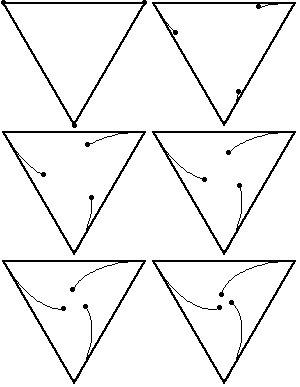
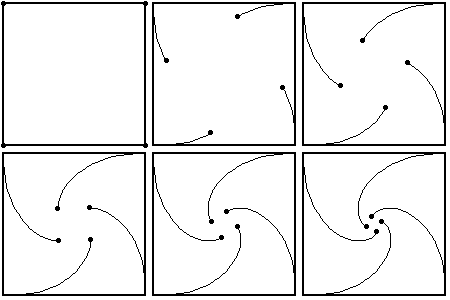
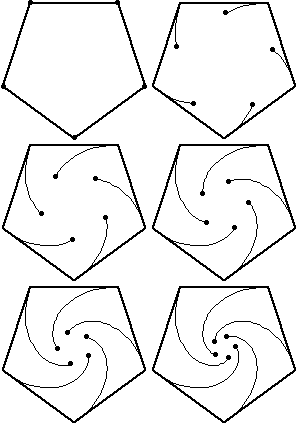
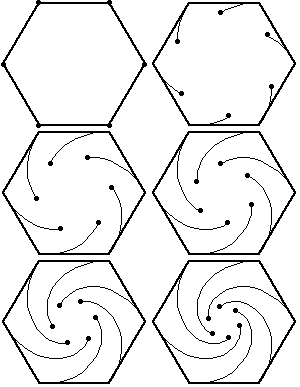
In the mice problem, also called the beetle problem, mice start at the corners of a regular -gon of unit side length, each heading towards its closest
neighboring mouse in a counterclockwise direction at constant speed. The mice each
trace out a logarithmic spiral, meet in the
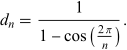
center of the polygon, and travel a distance
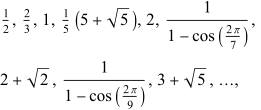
The first few values for ,
3, ..., are
giving the numerical values 0.5, 0.666667, 1, 1.44721, 2, 2.65597, 3.41421, 4.27432, 5.23607, .... The curve formed by connecting the mice at regular intervals of time
is an attractive figure called a whirl.
The problem is also variously known as the (three, four, etc.) (bug, dog, etc.) problem. It can be generalized to irregular polygons and mice traveling at differing speeds (Bernhart 1959). Miller (1871) considered three mice in general positions with speeds adjusted to keep paths similar and the triangle similar to the original.


 mice start at the corners of a regular
  -gon of unit side length, each heading towards its closest
neighboring mouse in a counterclockwise direction at constant speed. The mice each
trace out a logarithmic spiral, meet in the
center of the polygon, and travel a distance
-gon of unit side length, each heading towards its closest
neighboring mouse in a counterclockwise direction at constant speed. The mice each
trace out a logarithmic spiral, meet in the
center of the polygon, and travel a distance
 ,
3, ..., are
,
3, ..., are