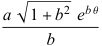
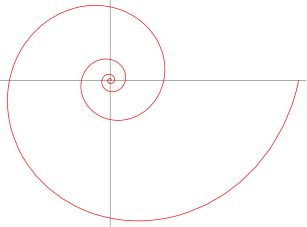
where
is the distance from the origin, is the angle from the x-axis,
and
and
are arbitrary constants. The logarithmic spiral is also known as the growth spiral,
equiangular spiral, and spira mirabilis. It can be expressed parametrically as
The logarithmic spiral can be constructed from equally spaced rays by starting at a point along one ray, and drawing the perpendicular to a neighboring ray. As the
number of rays approaches infinity, the sequence of segments approaches the smooth
logarithmic spiral (Hilton et al. 1997, pp. 2-3).
The logarithmic spiral was first studied by Descartes in 1638 and Jakob Bernoulli. Bernoulli was so fascinated by the spiral that he had one engraved on his tombstone (although the engraver did not draw it true to form) together with the words "eadem mutata resurgo" ("I shall arise the same though changed"). Torricelli worked on it independently and found the length of the curve (MacTutor Archive).
If
is any point on the spiral, then the length of the spiral from to the origin is finite. In fact, from the point which is at distance from the origin measured along a radius
vector, the distance from to the pole along the spiral is just
the arc length. In addition, any radius
from the origin meets the spiral at distances which are in geometric
progression (MacTutor Archive).



 is the distance from the origin,
  is the angle from the x-axis,
and
is the angle from the x-axis,
and  and
and  are arbitrary constants. The logarithmic spiral is also known as the growth spiral,
equiangular spiral, and spira mirabilis. It can be expressed parametrically as
are arbitrary constants. The logarithmic spiral is also known as the growth spiral,
equiangular spiral, and spira mirabilis. It can be expressed parametrically as







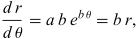
 is
is
 ,
,
 and the spiral approaches a circle.
 is any point on the spiral, then the length of the spiral from
  to the origin is finite. In fact, from the point
  which is at distance
  from the origin measured along a radius
vector, the distance from
from the origin measured along a radius
vector, the distance from  to the pole along the spiral is just
the arc length. In addition, any radius
from the origin meets the spiral at distances which are in geometric
progression (MacTutor Archive).
to the pole along the spiral is just
the arc length. In addition, any radius
from the origin meets the spiral at distances which are in geometric
progression (MacTutor Archive).
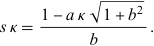
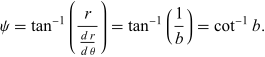
 ), curvature, and tangential
angle of the logarithmic spiral are given by
), curvature, and tangential
angle of the logarithmic spiral are given by