


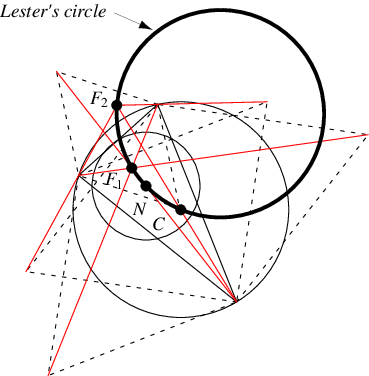
The Lester circle is the circle on which the circumcenter  , nine-point
center
, nine-point
center  ,
and the first and second Fermat points
,
and the first and second Fermat points  and
and  lie (Kimberling 1998, pp. 229-230). Besides these (Kimberling
centers
lie (Kimberling 1998, pp. 229-230). Besides these (Kimberling
centers  ,
,
 ,
,  , and
, and  , respective), no other notable triangle centers lie on
the circle.
, respective), no other notable triangle centers lie on
the circle.
The Lester circle has circle function
![l=-(f(a,b,c)R^2[1+2cos(2A)])/(6a^2bc(a^2-b^2)(a^2-c^2)),](/images/equations/LesterCircle/NumberedEquation1.svg) |
(1)
|
where
 |
(2)
|
does not appear to have a simple form and  does not appear in Kimberling's list of triangle centers.
The center of the Lester circle is
does not appear in Kimberling's list of triangle centers.
The center of the Lester circle is
![alpha=bc(b^2-c^2)[2(a^2-b^2)(c^2-a^2)+3R^2(2a^2-b^2-c^2)-a^2(a^2+b^2+c^2)+a^4+b^4+c^4],](/images/equations/LesterCircle/NumberedEquation3.svg) |
(3)
|
where  is the circumradius of the reference triangle, which
is Kimberling center
is the circumradius of the reference triangle, which
is Kimberling center  . The radius of the Lester circle is given by
 |
(4)
|
where  is a symmetric 16th-order polynomial that does not appear to have a simple form.
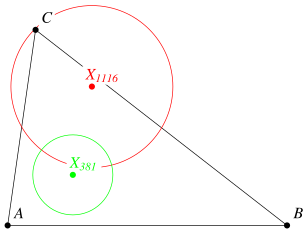
It is orthogonal to the orthocentroidal circle.

 Trott, M. "A Proof of Lester's Circle Theorem."