The Klein bottle is a closed nonorientable surface of Euler characteristic 0 (Dodson and Parker
1997, p. 125) that has no inside or outside, originally described by Felix Klein
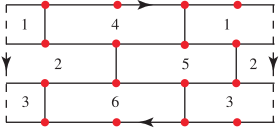
(Hilbert and Cohn-Vossen 1999, p. 308). It can be constructed by gluing both
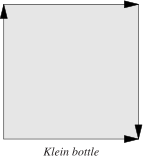
pairs of opposite edges of a rectangle together giving
one pair a half-twist, but can be physically realized only in four dimensions, since
it must pass through itself without the presence of a hole.
Its topology is equivalent to a pair of cross-caps
with coinciding boundaries (Francis and Weeks 1999). It can be represented by connecting
the side of a square in the orientations illustrated in the right figure above (Gardner
1984, pp. 15-17; Gray 1997, pp. 323-324).
It can be cut in half along its length to make two Möbius strips (Dodson and Parker 1997, p. 88), but can also be cut into a singleMöbius strip (Gardner 1984, pp. 14 and 17).
The above picture is an immersion of the Klein bottle in (three-space). There is also another
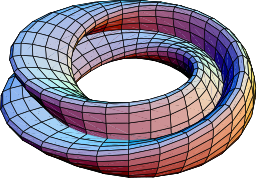
possible immersion called the "figure-8"
immersion (Apéry 1987, Gray 1997, Geometry Center).
While Gray (1997) depicts this embedding using the eight
curve (aka. lemniscate of Gerono), it can also be constructed using the usual
(Bernoulli) lemniscate (Pinkall 1985, Apéry
1987).
The equation for the usual immersion is given by the
implicit equation
(1)
(Stewart 1991). Nordstrand gives the parametric form
(2)
(3)
(4)
The "figure-8" form of the Klein bottle is obtained by rotating a figure eight about an axis while placing a twist in it, and is given by parametric
equations
(5)
(6)
(7)
for , , and (Gray 1997).
The image of the cross-cap map of a torus centered at the origin is a Klein bottle (Gray 1997, p. 339).
The Möbius shorts are topologically equivalent
to a Klein bottle with a hole (Gramain 1984, Stewart 2000).
Any set of regions on the Klein bottle can be colored using six colors only (Franklin 1934, Saaty and Kainen 1986), providing the sole exception to the Heawood
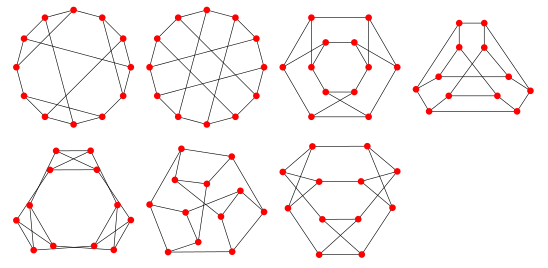
conjecture (Bondy and Murty 1976, p. 244). The 12-vertex graph (top figures)
whose embedding on the Klein bottle (bottom figure) divides it into regions having
a minimal coloring using six colors is known as the Franklin
graph.


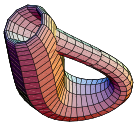
 (three-space). There is also another
possible immersion called the "figure-8"
immersion (Apéry 1987, Gray 1997, Geometry Center).
While Gray (1997) depicts this embedding using the eight
curve (aka. lemniscate of Gerono), it can also be constructed using the usual
(Bernoulli) lemniscate (Pinkall 1985, Apéry
1987).
(three-space). There is also another
possible immersion called the "figure-8"
immersion (Apéry 1987, Gray 1997, Geometry Center).
While Gray (1997) depicts this embedding using the eight
curve (aka. lemniscate of Gerono), it can also be constructed using the usual
(Bernoulli) lemniscate (Pinkall 1985, Apéry
1987).
![(x^2+y^2+z^2+2y-1)[(x^2+y^2+z^2-2y-1)^2-8z^2]
+16xz(x^2+y^2+z^2-2y-1)=0](/images/equations/KleinBottle/NumberedEquation1.svg)


![cosu[cos(1/2u)(sqrt(2)+cosv)+sin(1/2u)sinvcosv]](/images/equations/KleinBottle/Inline4.svg)


![sinu[cos(1/2u)(sqrt(2)+cosv)+sin(1/2u)sinvcosv]](/images/equations/KleinBottle/Inline7.svg)





![[a+cos(1/2u)sin(v)-sin(1/2u)sin(2v)]cos(u)](/images/equations/KleinBottle/Inline13.svg)


![[a+cos(1/2u)sin(v)-sin(1/2u)sin(2v)]sin(u)](/images/equations/KleinBottle/Inline16.svg)



 ,
,  , and
, and  (Gray 1997).

 Dickson, S. "Klein Bottle Graphic."