


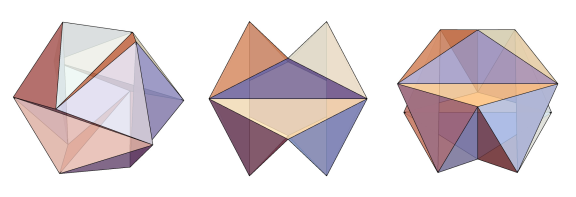
Jessen's orthogonal icosahedron is a concave shaky polyhedron constructed by replacing six pairs of adjacent triangles in an icosahedron (whose edges form a skew
quadrilateral) with pairs of isosceles triangles
sharing a common base. The polyhedron can be constructed from the 12 triples formed
by the cyclic permutations of  (Jessen 1967). When constructed from these points,
the short and long edges have lengths
(Jessen 1967). When constructed from these points,
the short and long edges have lengths  and 4, respectively.
The solid is implemented in the Wolfram Language as PolyhedronData["JessenOrthogonalIcosahedron"].
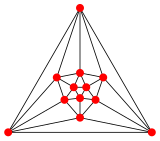
The skeleton of Jessen's orthogonal icosahedron is the icosahedral graph.
The polyhedron can be deformed infinitesimally by pinching the angles between the isosceles triangles whose bases act as hinges. If the polyhedron is constructed using paper and tape instead of entirely rigid faces, it is possible to collapse the isosceles triangles onto one another, resulting in an octahedron.
